
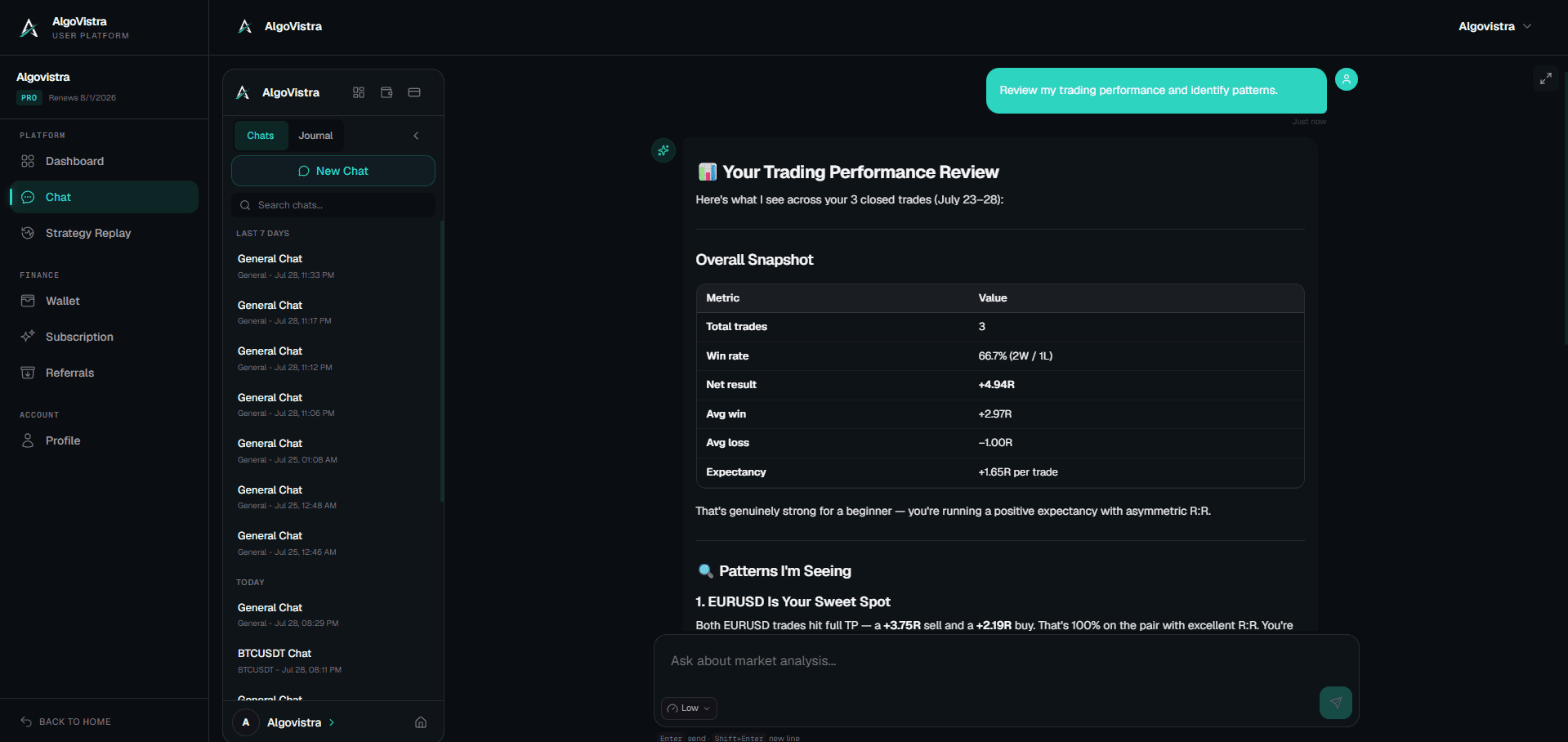
AlgoVistra product screenshot with sample workspace data; it is not verified trading performance.
Performance review is easy to postpone until a painful losing streak. A scheduled weekly review creates a regular opportunity to inspect decisions before memory and hindsight reshape them.
A weekly performance review is not about celebrating wins or mourning losses. It is about extracting one useful lesson and applying it the following week.
This guide shows a simple routine you can follow every Sunday evening, with or without an AI assistant.
Why Weekly Works
Monthly reviews cover too much ground. You forget why a trade felt right or wrong. Daily reviews consume energy you need for the next session. Weekly sits in the middle: long enough to see patterns, short enough to remember context.
A weekly review takes 30 to 60 minutes. Many traders find it one of the highest-value uses of that time, because it turns scattered results into decisions they can act on.
Step 1: Pull the Numbers
Start with hard data, not feelings.
- Total trades taken
- Win rate
- Average risk-to-reward (R:R)
- Net result in R and in dollars
- Best trade and worst trade of the week
- Pairs traded
- Sessions traded
Most journals and platforms can produce these statistics. AlgoVistra, for example, surfaces win rate, average R:R, P&L, and pair frequency from your journal entries.
Sample size matters from the first week. With fewer than roughly 20 trades, win rate and average R:R can swing widely and are not stable estimates of your process. Show the trade count beside every percentage and treat early numbers as directional signals, not verdicts.
Step 2: Filter by Setup and Pair
Aggregate numbers hide useful detail. Break them down:
- Which setup produced your best results this week?
- Which setup produced the worst?
- Did one pair account for most of your wins or losses?
- Were results concentrated in one session?
Patterns often appear here that the headline numbers hide. Two setups with the same win rate can have very different expectancy.
Step 3: Read the Notes
This is the part most traders skip. Open three to five journal entries and actually read what you wrote.
- Was your reasoning clear?
- Did the trade match your plan?
- Were you calm or anxious?
- What would you do differently?
Reading your own notes is uncomfortable. It is also the fastest way to improve.
Step 4: Identify One Lesson
Pick one lesson for the week. Not five. One.
Examples:
- "I am overtrading London open. I will only enter after the first 30 minutes next week."
- "My wins on EUR/USD are coming from 4H pullback setups. I will focus there."
- "I broke my stop rule twice this week. I will move stops to breakeven only after structure confirms."
Write the lesson down. Put it where you will see it during the next session.
Step 5: Update Rules and Plan
If a pattern repeats for several reviews, record it as a hypothesis and test it over a larger, consistently tagged sample before turning it into a permanent rule.
- Add the new rule clearly.
- Remove rules that no longer apply.
- Keep the plan short and usable.
AlgoVistra can store trader profile rules and reference them in future conversations. This keeps the plan alive instead of buried in a forgotten document.
Step 6: Ask the AI to Help
An AI trading assistant can speed up the review significantly.
Useful prompts:
- "Summarize my last 20 trades and group them by setup."
- "What is my average R:R for trades where I followed my plan versus trades where I did not?"
- "Which pair is producing my best win rate this month?"
- "What emotional patterns show up in my losing trades?"
The assistant does not replace your judgment. It organizes information faster so you can spend your time on the lesson.
Product example: The sample includes only three trades and says so visibly. A weekly review can still identify process issues at that size, but win rate and expectancy should not be treated as stable estimates.
A 45-Minute Review Template
| Time | Activity |
|---|---|
| 0–10 min | Pull weekly stats |
| 10–20 min | Filter by setup, pair, session |
| 20–30 min | Read 3–5 journal entries |
| 30–35 min | Identify one lesson |
| 35–40 min | Update plan or rules |
| 40–45 min | Ask AI for cross-checks |
What to Avoid
- Reviewing while tired — pick a time when you are alert.
- Skipping weeks — consistency is what makes the routine work.
- Changing five things at once — focus on one lesson.
- Ignoring the process — do not judge results; judge decisions.
The Compound Effect
A weekly review does not transform a process in a single week. Over time, a sufficiently large and consistently tagged record may reveal which setups and behaviors deserve a more formal test. Treat those patterns as estimates, not permanent truths.
If you want a workspace that combines your journal, statistics, AI analysis, and trader profile, AlgoVistra is built for exactly this kind of routine.
Statistics that belong in the review
Show trade count beside every percentage. Define R consistently, separate gross from net results, include fees and slippage, report median as well as mean, and group results only when each tag was assigned before reviewing the outcome. Keep an unchanged copy of the original journal so a later narrative cannot silently rewrite the sample.
The CFA Institute backtesting and simulation overview covers sample-dependent risks such as look-ahead bias and structural breaks. Its material on trading costs and electronic markets explains spread- and execution-based cost measures. The screenshot above is a transparent small-sample product example, not evidence of representative AlgoVistra user returns.
Disclaimer: AI trading assistants provide analytical insights for educational and informational purposes. They do not constitute financial advice. Always conduct your own research and use proper risk management.
Review Your Trading With Evidence
Use your journal history, stats, and visual trade reviews to examine execution and make your process more deliberate. The free plan includes 10 AI chat messages per day.
Emotional Trading: How to Track and Reduce Impulse Decisions
A practical, non-judgmental guide to recognizing emotional trading patterns and reducing impulse decisions in your trading.
June 5, 2026GuideFrom Journal to Trading Plan: Turning 30 Trades Into Rules
How to convert patterns you find in your trading journal into a clear, usable trading plan that actually fits your style.
June 4, 2026GuideHow to Keep a Trading Journal That Actually Improves Your Results
A practical guide to keeping a trading journal that helps you learn from your decisions, spot patterns, and build a more deliberate trading process.
June 2, 2026