
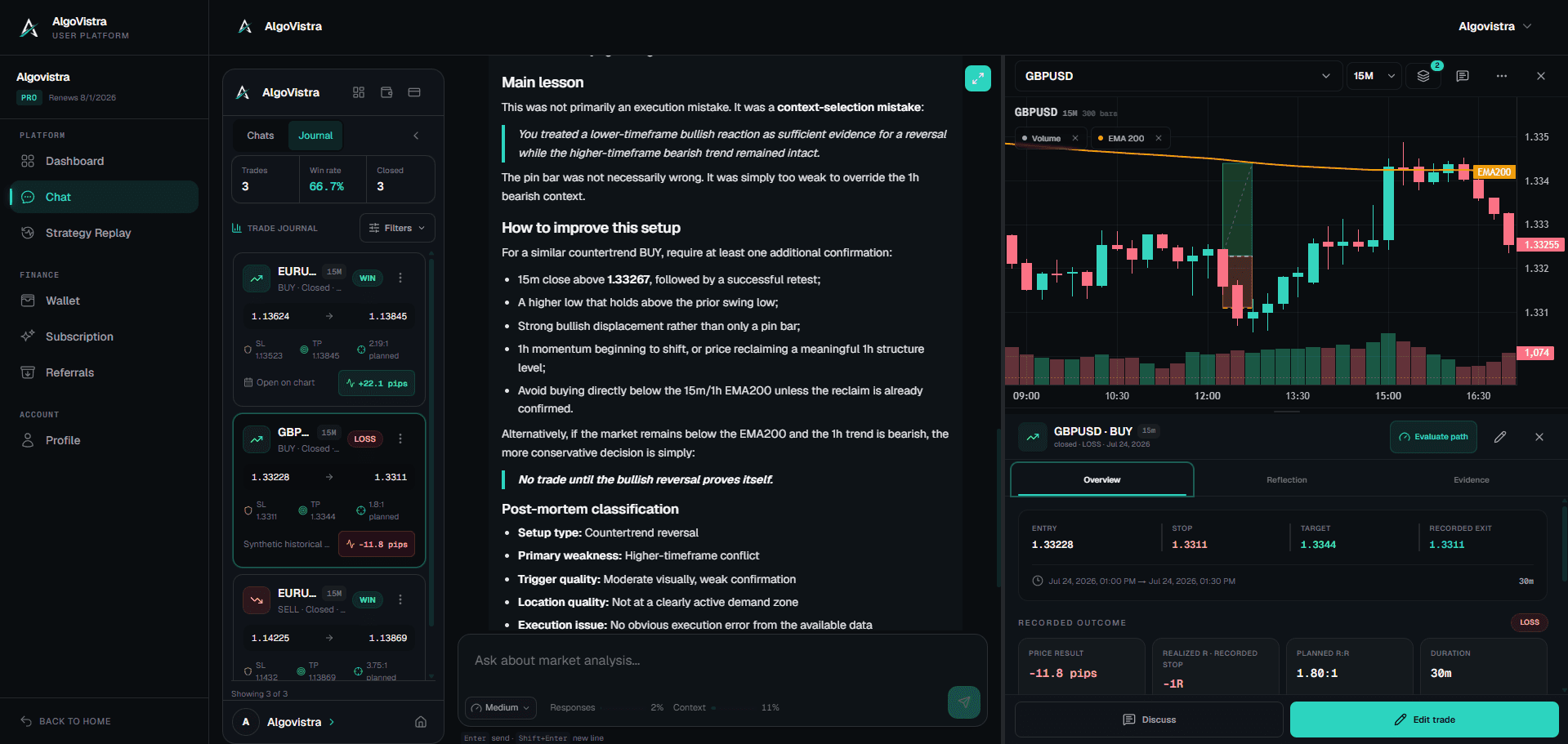
AlgoVistra product screenshot with sample workspace data; it is not verified trading performance.
Every trader has been there. The candle moves against you, and suddenly you are closing the chart and reopening it. You are looking for the next setup not because you see one, but because you need to do something.
This is not a character flaw. It is how the human brain responds to loss and uncertainty. The good news: emotional patterns are visible, and visible patterns can be changed.
This guide offers a non-judgmental way to track, understand, and reduce impulse decisions.
Why Emotions Drive Trades
Trading involves three sources of stress:
- Real money at risk — losses feel personal
- Uncertain outcomes — the brain dislikes ambiguity
- Speed of decisions — there is no time to fully think
Under stress, the brain defaults to fast, emotional responses. In trading, that looks like chasing, revenge trading, holding losers too long, or cutting winners too early. None of these are signs of stupidity. They are signs of an overloaded decision system.
The Most Common Emotional Triggers
You will likely see most of these in your journal if you look honestly:
- Revenge — entering a new trade immediately after a loss to "make it back"
- FOMO — entering because price moved without you
- Boredom — taking a low-quality trade because there is "nothing to do"
- Euphoria — over-sizing after a winning streak
- Anxiety — closing a winner early or moving a stop against the plan
- Denial — holding a loser because admitting the loss feels worse than the loss itself
Naming the pattern is the first step. You cannot fix what you refuse to see.
How to Track Emotions in Your Journal
Add an emotional state field to your journal entries. Use simple, honest labels:
- Calm
- Confident
- Anxious
- FOMO
- Revenge
- Bored
- Euphoric
- Uncertain
Do not try to be precise. The point is to notice, not to perform a psychological analysis.
What the Data Shows
After a few weeks of consistent logging, you can ask your journal some useful questions:
- What emotional state is most common in my losing trades?
- Are my revenge trades concentrated on certain days or after certain losses?
- Do I over-size when feeling euphoric?
- Are my winners cut short because of anxiety?
These patterns are uncomfortable to see. They are also the fastest path to fewer mistakes.
How to Reduce Impulse Decisions
Pre-Commit to Rules
Decide in advance what you will do. The brain under stress is not creative. It needs defaults.
Examples:
- "I will not enter a new trade for 30 minutes after a loss."
- "I will not size up after a winning streak."
- "I will not move my stop against the original level."
Store these rules in your trader profile. AlgoVistra can reference them in future conversations, which keeps them active even when your brain is not.
Use a Checklist Before Entry
A short, mandatory checklist removes the "should I?" question that triggers emotional thinking.
- Is this setup in my plan?
- Is the higher timeframe trend in my favor?
- Is my risk within my limit?
- Is this a calm decision or an emotional one?
If the answer to the last question is "emotional," skip the trade.
Add Friction to Bad Decisions
Impulse decisions happen in seconds. Add small delays:
- Close the chart and walk away for 5 minutes.
- Write the trade idea down before placing it.
- Set a phone reminder that asks "is this in your plan?"
These tiny frictions stop the fast loop that drives emotional trades.
Reduce Session Length
A long session drains the brain and increases emotional decisions. A 90-minute focused session is usually more productive than a 4-hour distracted one.
Review With Compassion
When you find a revenge trade in your journal, do not call yourself names. Note it. Ask what triggered it. Adjust a rule. Move on. Self-criticism increases stress, which increases more emotional decisions.
How AI Helps With Emotional Discipline
An AI trading assistant is useful for emotional trading in three ways.
Pattern Detection
Ask the assistant to find emotional patterns in your journal:
- "Which of my trades were marked as revenge or FOMO?"
- "Do my revenge trades tend to happen after losses above a certain size?"
- "What is the average result of trades tagged 'anxious' versus 'calm'?"
Pre-Trade Check-ins
Before entering, ask:
- "I am considering a long on GBP/USD after a losing trade. Does my profile say anything about this kind of setup?"
The assistant can reference your stored rules and remind you what you committed to.
Cool-Down Prompts
When you have just had a loss, you can ask:
- "Help me take a 30-minute break and structure my next decision."
The assistant will not trade for you, but it can slow the loop and help you think clearly.
Product example: This sample review separates the trade result from the process lesson. The values are demonstration data, not evidence that a specific intervention improves returns. Use your own tagged journal entries to test whether an emotional state is associated with rule-breaking.
The Real Goal
The goal is not to eliminate emotions. You cannot do that, and trying creates a different kind of tension. The goal is to notice emotions, separate them from the chart, and act only when the decision is calm and clear.
When your journal shows a repeatable relationship between an emotional tag and rule-breaking, the record gives you something concrete to change. It does not prove that every emotional trade loses or every calm trade wins.
AlgoVistra combines journaling, trader profile rules, and AI analysis so you can see emotional patterns and act on them deliberately.
What the research does and does not show
A study using actual trader behavior found measurable relationships between emotion-related variables and trading decisions, while also showing that those relationships are more nuanced than “emotion is bad.” See the open-access paper, Emotions and Trading Behavior.
For behavior change, a meta-analysis of mental contrasting with implementation intentions found a small-to-moderate average effect on goal attainment and noted possible publication bias. That supports a modest practice: turn a journal pattern into an if-then rule—“If I feel urgency after a loss, then I pause for ten minutes and rerun the checklist”—and test it on your own records.
Disclaimer: AI trading assistants provide analytical insights for educational and informational purposes. They do not constitute financial advice. Always conduct your own research and use proper risk management.
Keep Your Journal Inside the Conversation
Log trades in natural language and let AI surface patterns, emotions, and lessons from your own record. The free plan includes 10 AI chat messages per day.
How to Keep a Trading Journal That Actually Improves Your Results
A practical guide to keeping a trading journal that helps you learn from your decisions, spot patterns, and build a more deliberate trading process.
June 2, 2026GuideTrading Performance Review: A Weekly Routine Using AI
A repeatable weekly review routine that uses your trading journal, statistics, and an AI assistant to improve your process.
June 3, 2026GuideFrom Journal to Trading Plan: Turning 30 Trades Into Rules
How to convert patterns you find in your trading journal into a clear, usable trading plan that actually fits your style.
June 4, 2026