
How to Keep a Trading Journal That Actually Improves Your Results
A practical guide to keeping a trading journal that helps you learn from your decisions, spot patterns, and build a more deliberate trading process.
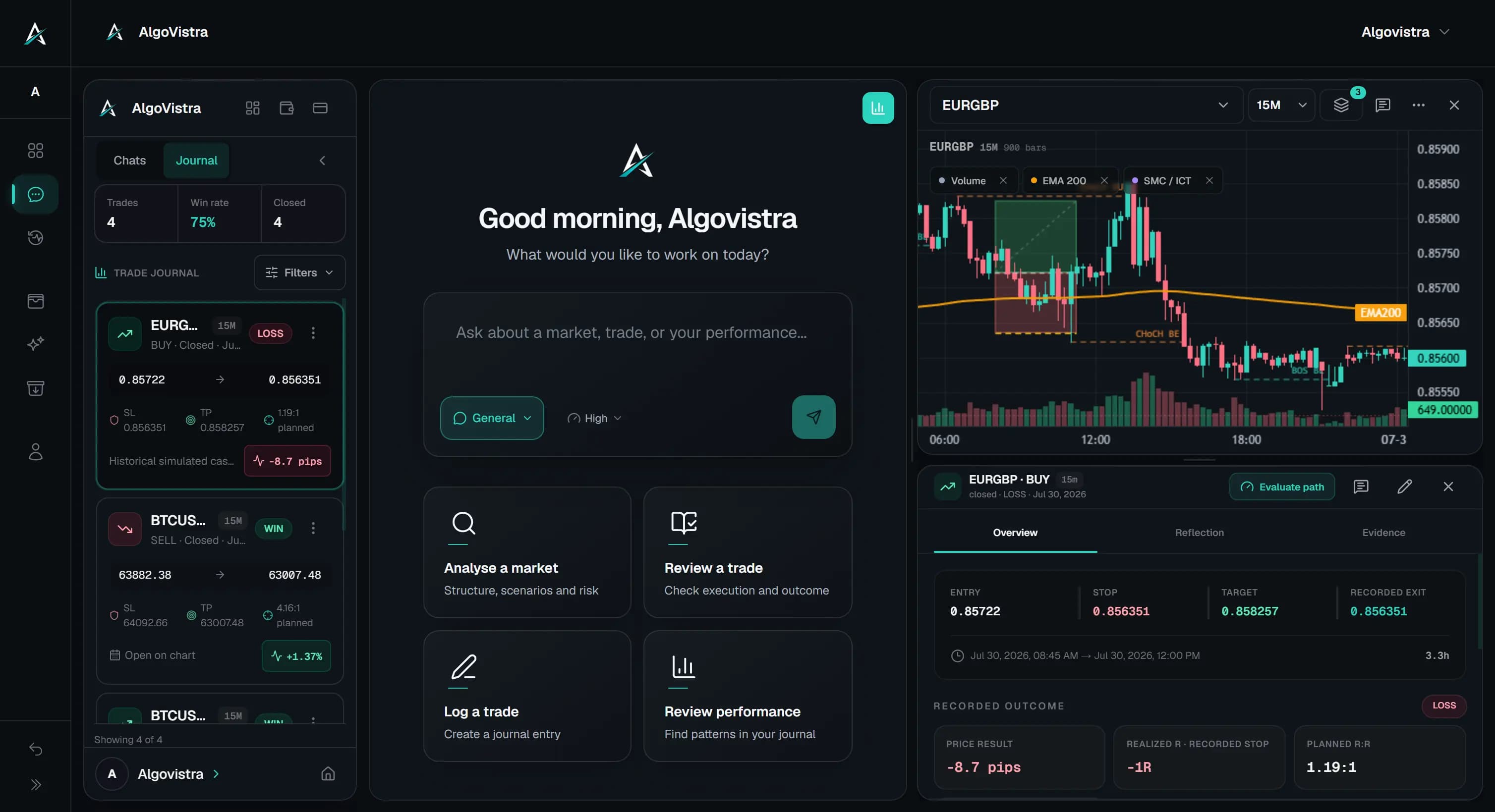
Original AlgoVistra educational diagram; illustrative only, not live market data.
A trading journal is not a list of wins and losses. It is a record of decisions, conditions, and reasoning. Kept well, it becomes the most honest feedback loop you have. Kept poorly, it becomes a graveyard of screenshots you never look at again.
This guide shows how to keep a trading journal that actually changes how you trade.
Why Most Journals Fail
Traders abandon journals for predictable reasons:
- Too many fields — forms so long that filling them feels like a second job
- No review step — entries are saved and never opened again
- Focus on outcome, not process — the journal only records profit and loss
- No structure — random notes that cannot be compared week to week
- Disconnected from charts — the actual market context disappears
A good journal records the decision, not just the result. It captures what you saw, what you thought, and what you did. The result is secondary context.
What to Record for Every Trade
Aim for fields that help you reconstruct the decision later. A simple but complete set includes:
Market Context
- Pair (e.g. EUR/USD, BTC/USDT)
- Timeframe analyzed
- Session (Asia, London, New York)
- Higher-timeframe trend direction
- Key levels, POC, or zones watched
Setup
- Reason for the trade
- Pattern or condition that triggered the idea
- Confluence with structure, volume, or news
Trade Details
- Direction (long or short)
- Entry price
- Stop loss
- Take profit
- Position size
- Risk as a percentage of account
Decision Notes
- Why you entered
- What would invalidate the trade
- What you expected to happen
- How you felt (calm, anxious, FOMO, revenge)
Result and Reflection
- Exit price
- Result (win, loss, breakeven, open)
- What actually happened
- What you would do differently
You do not need to fill every field for every trade. But over time, consistency matters more than perfection.
When to Journal
Three moments matter:
- Before the trade — capture the setup and invalidation.
- At exit — record the result and your emotional state.
- At review — discuss the trade later with hindsight.
The middle moment is the easiest to skip. After a win, you feel great. After a loss, you want to forget. Both are exactly when you should write.
Reviewing Your Journal
A journal without review is just storage. Build a weekly review habit:
- Pick a fixed day and time (Sunday evening works for many traders).
- Filter last week's trades by pair, session, and result.
- Look for patterns in your notes.
- Identify one lesson to apply next week.
- Update your trading plan or rules if a real pattern emerges.
Common Patterns to Look For
After a few weeks of consistent journaling, you can search for patterns — but only trust a pattern once it has enough supporting entries. A couple of similar trades can look meaningful by coincidence. Treat a tendency as real only after it repeats across a meaningful sample, often a few dozen logged decisions for a single setup, pair, or session.
- Setup quality — are your wins coming from specific setups?
- Loss clusters — do losses happen around news, certain sessions, or specific pairs?
- Emotional triggers — are revenge trades or FOMO entries concentrated on certain days?
- Rule breaks — how often do you deviate from your own plan?
- Risk consistency — are some trades risking much more than others?
Using AI to Speed Up Journaling
An AI trading assistant like AlgoVistra can make journaling easier:
- Log trades conversationally by describing them in chat.
- Let the assistant extract and structure the fields automatically.
- Ask the assistant to summarize patterns across trades.
- Review saved journal entries on the historical chart where they happened.
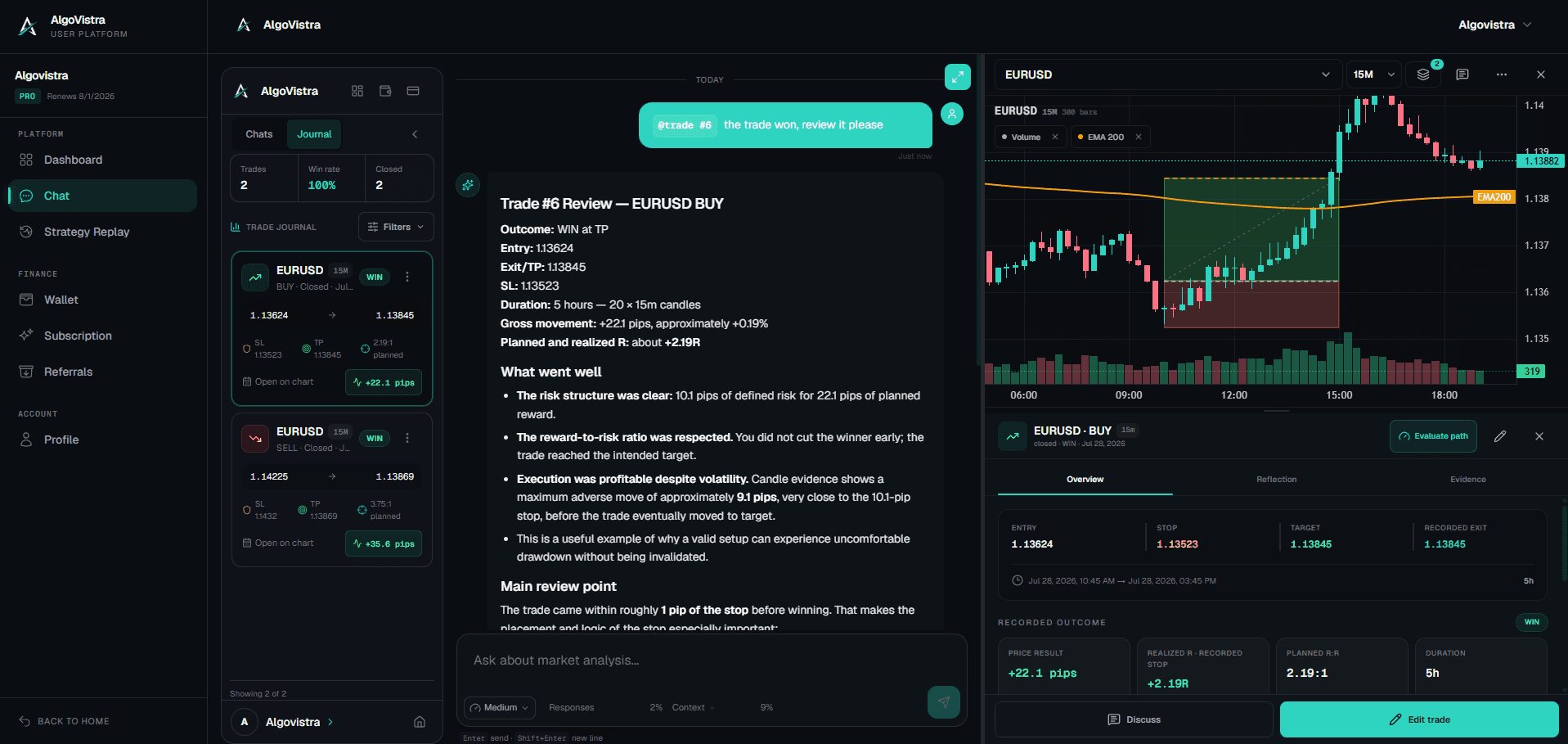
Product example: The sample review keeps the written decision beside the historical price path. That makes it possible to distinguish a bad outcome from a bad process and reduces hindsight-only explanations.
This saves time and reduces the friction of manual form-filling.
A Simple Journal Template
If you do not have a journal yet, start with a single line per trade:
2026-06-02 | EUR/USD 4H long | entry 1.0850, stop 1.0820, target 1.0900 | risk 1% | reason: pullback to 4H support with bullish engulfing | result: win +1.5R | note: entered calmly, followed plan
That is enough. Over time, expand to full fields. Consistency beats complexity.
The Real Benefit
A journal does not guarantee better returns. A complete record can improve clarity by replacing memory with inspectable decisions, conditions, and outcomes.
That clarity is what makes a trading process deliberate.
If you want to try AI-assisted journaling, AlgoVistra can log trades by description, store them with structured fields, and display them on the chart where they happened.
A journal entry you can audit
A useful record preserves facts available at decision time: instrument and venue, timezone, entry and exit timestamps, side, size, entry, stop, target, fees, screenshot, thesis, invalidation, setup tag, emotional state, and whether each rule was followed. Record the result in both cash and R, then separate “process verdict” from “outcome.” That structure makes later comparisons possible.
Evidence for journaling as a trading intervention is limited, so avoid claiming that journaling alone improves returns. Broader self-regulation research finds that self-monitoring can help in some behavior-change contexts but results vary; see this systematic meta-review. The open-access study Emotions and Trading Behavior is useful background for why actual decision records are more informative than generic claims about trader psychology.
Disclaimer: AI trading assistants provide analytical insights for educational and informational purposes. They do not constitute financial advice. Always conduct your own research and use proper risk management.
Keep Your Journal Inside the Conversation
Log trades in natural language and let AI surface patterns, emotions, and lessons from your own record. The free plan includes 10 AI chat messages per day.
Emotional Trading: How to Track and Reduce Impulse Decisions
A practical, non-judgmental guide to recognizing emotional trading patterns and reducing impulse decisions in your trading.
June 5, 2026GuideFrom Journal to Trading Plan: Turning 30 Trades Into Rules
How to convert patterns you find in your trading journal into a clear, usable trading plan that actually fits your style.
June 4, 2026GuideTrading Performance Review: A Weekly Routine Using AI
A repeatable weekly review routine that uses your trading journal, statistics, and an AI assistant to improve your process.
June 3, 2026