
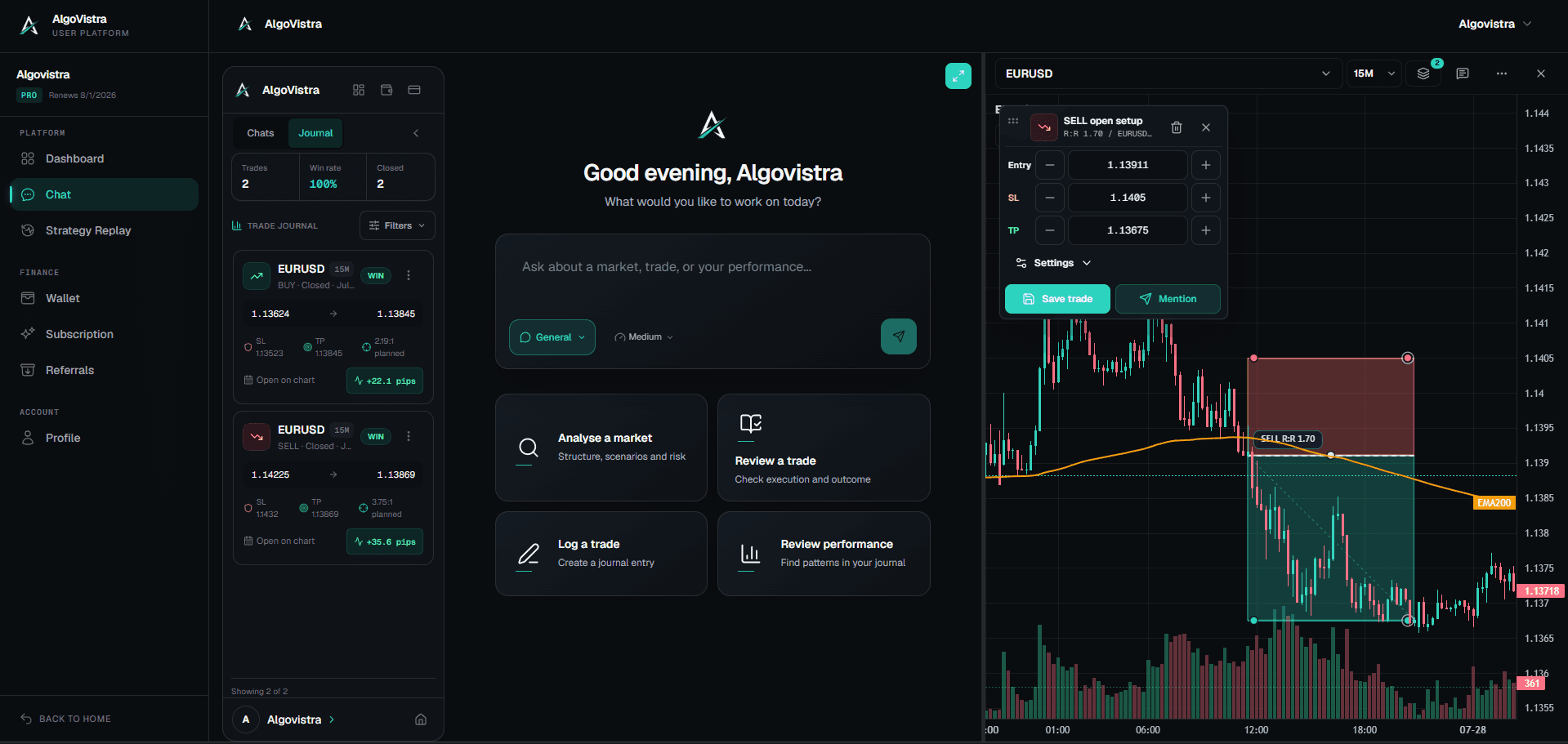
AlgoVistra product screenshot with sample workspace data; it is not verified trading performance.
A trading journal shows you what you actually do. A trading plan tells you what you intend to do. The bridge between the two is where most traders get stuck.
This guide walks through turning 30 or more journaled trades into a focused, usable trading plan.
Why 30 Trades Is a Good Starting Point
Twenty to thirty trades is enough to see rough patterns without locking in noise. Fewer than that and you are reacting to a few wins or losses. More than fifty and you have probably already wasted months on setups that do not work.
If you are starting from scratch, treat the first 30 trades as a learning batch, not a performance test.
Step 1: Sort Trades by Result and Reason
Open your journal and group trades by the reason you entered. Use simple categories:
- Pullback to support or resistance
- Break of structure
- Liquidity sweep
- News-driven move
- Range top or bottom
- Revenge or impulse (be honest)
- Other
Within each group, note the result: win, loss, breakeven, or open. Patterns will start to appear.
Step 2: Find Your Best Setups
Look for the categories that consistently show:
- High win rate
- High average R:R
- Clear chart condition before entry
- Predictable behavior after entry
These are your core setups. A trader rarely needs more than three.
If you find a category with a poor win rate but very high R:R, that is also valid. Some setups lose often and win big. Document that.
Step 3: Find Your Worst Habits
Equally important, identify trades that broke your existing plan or had no plan at all.
- Revenge trades after a loss
- FOMO entries after seeing price move
- Trades taken during low-liquidity sessions
- Stops moved against the original plan
- Position size larger than usual
These are not setups. They are habits. Each one becomes a rule in your plan: "I will not enter for 30 minutes after a loss" or "I will not move my stop against the original level."
Step 4: Write the Plan in Plain Language
A trading plan should be readable in five minutes. Use clear, testable statements. Avoid vague phrases like "trade with discipline" or "manage risk properly."
A simple plan structure:
Purpose
A short paragraph describing your trading style and target. Example: "Trade forex and crypto pullbacks on the 4H and daily, with a target of consistent small gains and strict risk control."
Markets and Sessions
The pairs and time windows you trade. Example: "EUR/USD, GBP/USD, BTC/USDT, ETH/USDT. London and New York sessions only."
Setups
A list of three or fewer setups with the conditions that define each one. Example: "4H pullback to demand zone with bullish engulfing candle and volume confirmation."
Risk Rules
- Maximum risk per trade
- Daily and weekly loss limits
- Stop placement policy
- Position sizing method
Entry Checklist
What must be true before you enter. Keep it short.
Exit Rules
How and when you exit. Predefined targets, trailing rules, time-based exits.
Rules Against Common Mistakes
Specific reminders based on your worst habits. Example: "No trading for 30 minutes after a loss."
Review Schedule
When and how you review. Example: "Every Sunday, 45-minute review."
Product example: A structured journal entry is the raw material for the plan. The form records the market, direction, levels, result, setup, emotion, and lesson so later rules can be based on comparable fields rather than memory.
Step 5: Store the Plan Where You Will Use It
A plan buried in a folder is useless. Options:
- Print it and keep it next to your trading desk
- Save it in your phone for quick reference
- Store it in your trader profile inside your trading platform
AlgoVistra supports a persistent trader profile that can store your plan, rules, and preferences. The assistant can reference them in future conversations so the plan stays active.
Step 6: Test the Plan for 30 More Trades
Once the plan is written, run it for another batch of 30 trades. Do not edit it mid-batch. The point is to test the plan as written.
After the second batch:
- Compare results with the first batch.
- Identify setups that are not performing as expected.
- Adjust only the rules that are clearly broken.
Common Mistakes
- Copying someone else's plan — their psychology and schedule are not yours.
- Too many setups — three clear setups beat ten fuzzy ones.
- No invalidation in the plan — every rule needs a way to be wrong.
- Editing every week — give the plan time to work.
How AI Helps Build the Plan
An AI trading assistant can draft a first version of your plan based on your journal.
Useful prompts:
- "Based on my last 30 trades, suggest three setups that match my best results."
- "What habits appear most often in my losing trades?"
- "Draft a risk management section for a plan that risks 1% per trade with a 2R target."
The assistant cannot replace your judgment, but it can speed up the writing process significantly.
From Reactive to Deliberate
A journal captures what happened. A plan decides what happens next. Together, they turn trading from a series of reactions into a deliberate process you control.
If you want a workspace that connects your journal, plan, and AI analysis, AlgoVistra keeps all three in the same conversation.
Turn observations into testable rules
Do not convert a pattern from 30 trades directly into a universal truth. State the observed sample and write the rule as a prospective test. Example: “In the last 30 logged trades, 8 London-session breakout entries met the current tag definition; 5 broke the chase rule. For the next 20 eligible setups, I will only enter after the predefined retest and will log every skipped setup.”
Research on self-regulation is broader than trading, but it offers useful caution and structure. A meta-review of self-regulation mechanisms found evidence for self-monitoring and goal setting in several behavior-change contexts while emphasizing mixed results across mechanisms. A meta-analysis of implementation intentions found a small-to-moderate average effect on goal attainment. Use those ideas to form specific if-then rules, then validate them against your own future journal rather than claiming they guarantee performance.
Disclaimer: AI trading assistants provide analytical insights for educational and informational purposes. They do not constitute financial advice. Always conduct your own research and use proper risk management.
Keep Your Journal Inside the Conversation
Log trades in natural language and let AI surface patterns, emotions, and lessons from your own record. The free plan includes 10 AI chat messages per day.
Trading Performance Review: A Weekly Routine Using AI
A repeatable weekly review routine that uses your trading journal, statistics, and an AI assistant to improve your process.
June 3, 2026GuideHow to Keep a Trading Journal That Actually Improves Your Results
A practical guide to keeping a trading journal that helps you learn from your decisions, spot patterns, and build a more deliberate trading process.
June 2, 2026GuideEmotional Trading: How to Track and Reduce Impulse Decisions
A practical, non-judgmental guide to recognizing emotional trading patterns and reducing impulse decisions in your trading.
June 5, 2026