
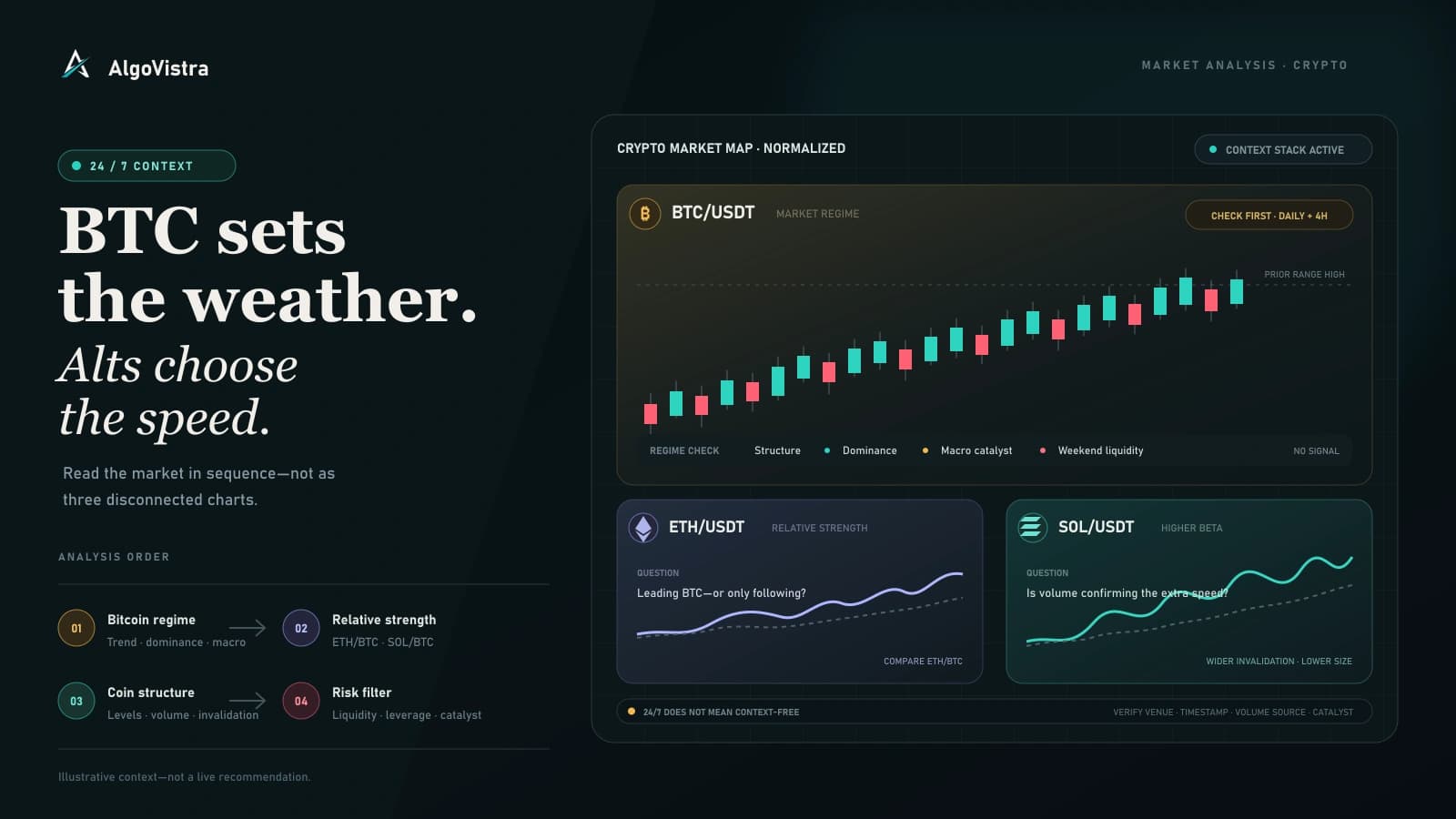
Original AlgoVistra educational diagram; illustrative only, not live market data.
Crypto markets trade 24/7 and move faster than almost any other asset class. Bitcoin, Ethereum, and Solana each have their own personalities, liquidity profiles, and macro sensitivities. For traders, the challenge is keeping up without burning out.
An AI trading assistant can help by summarizing structure, volume, and key levels across multiple timeframes in seconds. This guide offers a practical workflow for crypto analysis.
Why Crypto Is Different
Before using AI on crypto, understand what makes these markets unique:
- 24/7 price action — no market close means patterns develop continuously.
- High volatility — large moves can happen in minutes.
- Narrative sensitivity — news, ETF approvals, regulatory action, and exchange events move prices fast.
- Liquidity gaps — altcoins especially can gap through levels on low volume.
- Bitcoin dominance — BTC often sets the tone for the rest of the market.
A good AI assistant accounts for these factors instead of treating crypto like forex.
Bitcoin (BTC/USDT)
Bitcoin is generally considered one of the most macro-sensitive crypto assets. It often reacts to dollar strength, ETF flows, Fed policy, and global risk appetite.
Useful prompts:
- "What is the weekly and daily structure on BTC/USDT?"
- "Where is the current point of control and value area?"
- "Is BTC showing a break of structure or just a range expansion?"
- "What macro events this week could invalidate the current bias?"
Bitcoin analysis benefits from combining weekly structure with 4H execution levels.
Ethereum (ETH/USDT)
Ethereum moves with Bitcoin but has its own catalysts: staking flows, network upgrades, DeFi activity, and ETF developments.
Useful prompts:
- "How is ETH/USDT performing relative to BTC/USDT?"
- "What are the key support zones on ETH 4H?"
- "Is there a bullish or bearish market structure shift?"
- "What invalidation level should I watch for an ETH long?"
ETH often lags BTC on strong moves; some traders find that lag can offer entries at better prices when the trend is clear. That is a tendency to verify on your own data rather than a rule.
Solana (SOL/USDT)
Solana is a higher-beta altcoin. It can outperform BTC and ETH in bullish phases and fall harder in corrections.
Useful prompts:
- "What is the trend structure on SOL/USDT daily?"
- "Where are the recent swing highs and lows?"
- "Is volume confirming the current move?"
- "What would confirm a trend reversal versus a pullback?"
For altcoins, always check Bitcoin dominance and BTC trend. A weak BTC environment often drags altcoins lower regardless of their own setup.
A Crypto Analysis Workflow
Here is a repeatable workflow you can use before taking a crypto trade:
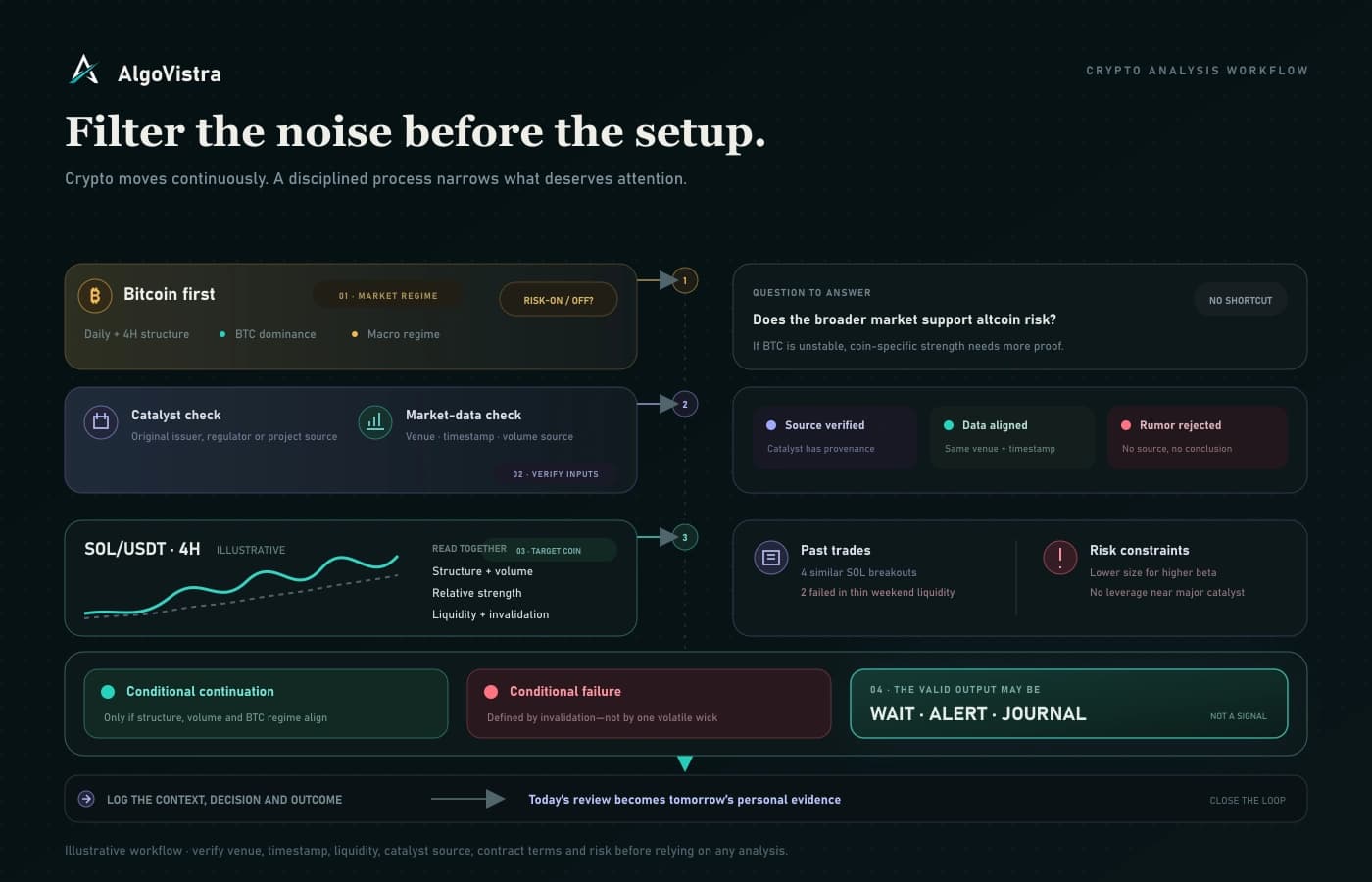
Decision stack: Establish the Bitcoin regime first, verify catalysts and venue-specific data, then evaluate the target coin alongside relevant journal history and personal risk constraints. A valid result may be to wait, set an alert, or journal the observation rather than enter a trade.
- Check BTC bias — ask for Bitcoin's daily and 4H structure.
- Check dominance — if available, ask how BTC dominance affects altcoin risk.
- Analyze your target coin — request structure, levels, and volume profile.
- Evaluate your idea — share entry, stop, target, and ask for confirmation/invalidation.
- Set alerts and journal — record the setup before price reaches your level.
This prevents emotional entries and keeps your process documented.
Crypto-Specific Risk Reminders
- Use wider invalidations — crypto can wick through levels before reversing.
- Avoid over-leverage — volatility makes leverage dangerous.
- Watch weekend liquidity — thinner books can produce fake breakouts.
- Correlate with BTC — most altcoins follow Bitcoin's lead in risk-off moves.
Using AI Without Overtrading
Crypto never sleeps, but you should. Use the assistant to organize your watchlist and levels, then step away. The goal is not to catch every move; it is to evaluate only the setups that fit your predefined plan.
AlgoVistra supports major crypto pairs including BTC/USDT, ETH/USDT, and SOL/USDT, with multi-timeframe analysis through chat.
Source checks for a crypto workflow
Crypto analysis needs a stronger source check than a chart-only narrative. The SEC's crypto asset investor alert describes the volatility, illiquidity, platform, fraud, and investor-protection risks that can affect crypto markets. The CFTC's virtual-currency risk advisory also emphasizes volatility, leverage, manipulation, cybersecurity, and platform safeguards.
Before acting on an AI summary, verify the instrument and venue, the candle timestamp, whether volume is exchange-specific, the next scheduled macro event, and whether the cited catalyst comes from an original issuer or regulator. The workflow above is educational and does not establish a tested BTC strategy.
Disclaimer: AI trading assistants provide analytical insights for educational and informational purposes. They do not constitute financial advice. Always conduct your own research and use proper risk management.
Ready to Trade Smarter?
Get 10 AI chat messages per day on the free plan. No credit card required.
Gold Trading Analysis: XAU/USD Key Levels and Macro Context
How to analyze gold (XAU/USD) using macro context, key levels, market structure, and an AI trading assistant.
June 8, 2026GuideVolume Profile Trading: HVN, LVN & POC Explained
Master volume profile trading with our complete guide to High Volume Nodes, Low Volume Nodes, and Point of Control.
June 1, 2026GuideMulti-Timeframe Analysis: How to Align Daily, 4H, and 1H Charts
Learn how to use multi-timeframe analysis to identify trend direction, key levels, and better entry timing in forex, crypto, and gold markets.
May 28, 2026