
What Is an AI Trading Assistant? A Complete Guide for 2026
Learn how AI trading assistants analyze live market data, support trade decisions, and help traders improve through personalized context, journaling, and review.
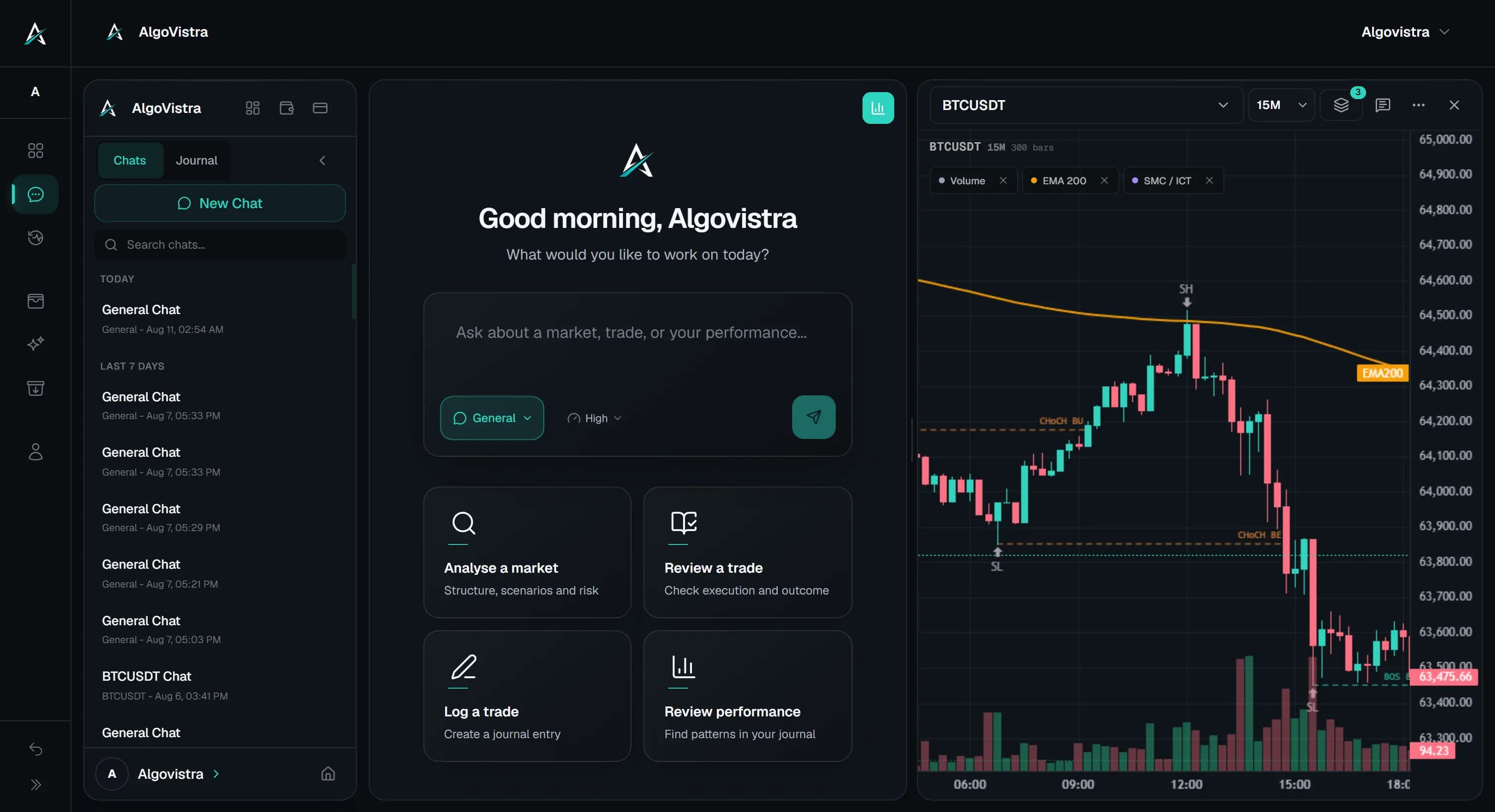
Original AlgoVistra educational diagram; illustrative only, not live market data.
An AI trading assistant is a software tool that uses artificial intelligence to analyze financial markets and support trading decisions. Unlike traditional trading tools that require you to read charts manually or code your own indicators, an AI trading assistant processes market data across multiple timeframes and explains what it sees in plain, conversational language.
AlgoVistra is built as an AI-native trading workspace for forex, gold, crypto, and index traders. It combines live and historical market analysis with persistent trader context, a conversational journal, visual trade review, and performance reflection. The goal is not to replace the trader, but to give you clearer evidence, faster context, and a better feedback loop for your own decisions.
How AI Trading Assistants Work
Most AI trading assistants follow a similar pipeline: collect data, detect patterns, reason through context, and deliver an explanation.
1. Data Collection
The assistant pulls real-time market data from supported sources. This usually includes price data, volume, and sometimes macroeconomic news or event calendars. The data is collected across multiple timeframes so the assistant can compare short-term price action against longer-term structure.
2. Pattern Detection
Algorithmic detectors identify common market features:
- Market structure: trends, break of structure (BOS), change of character (CHoCH)
- Price action: candlestick patterns, swings, and key reactions
- Volume profile: high volume nodes (HVN), low volume nodes (LVN), point of control (POC)
- Technical indicators: moving averages, RSI, MACD, and similar tools
- Macro context: scheduled news events that may affect volatility
3. AI Reasoning
A large language model evaluates the detected patterns together. Instead of firing a signal whenever one indicator lines up, the model weighs confluence, conflicting evidence, and current market context. This produces a more nuanced read than a simple rule-based alert.
4. Insight Delivery
The result is delivered through chat. You can ask follow-up questions, request a different timeframe, compare two pairs, or ask for an explanation of a concept. The interaction feels more like a conversation with an analyst than a dashboard scan.
What an AI Trading Assistant Is Not
This distinction matters for both trust and performance.
- It is not a guaranteed signal service. No AI can predict markets with certainty.
- It is not a broker. It does not execute trades on your behalf.
- It is not financial advice. It provides analysis and educational context; the final decision is always yours.
- It is not a replacement for risk management. Stop losses, position sizing, and account protection remain your responsibility.
The best way to use an AI trading assistant is as a second opinion, a research partner, and a learning tool.
Who Benefits from an AI Trading Assistant?
AI trading assistants are useful for a wide range of traders:
- Learning traders who want concepts explained in chart context
- Busy professionals who cannot watch charts all day
- Active traders who want faster multi-timeframe reads
- Analysis-first traders who prefer reasoning over alerts
- Journal keepers who want to connect market reads with their own recorded decisions
AlgoVistra's Approach
AlgoVistra extends the basic assistant idea in a few specific ways:
- Persistent trader profile: your style, pairs, sessions, risk limits, and rules can be saved and referenced in future conversations.
- Conversational journal: log trades by describing them naturally, then review them later with statistics and historical charts.
- Visual trade review: open a saved journal entry on the chart where it happened.
- Performance reflection: discuss recorded results, emotions, mistakes, and lessons with the assistant.
This creates a loop: analyze, decide, record, review, and improve.
Getting Started
If you are curious about AI-assisted trading analysis, the simplest way to begin is to ask a specific question about a market you follow. Instead of "Should I buy?", try:
- "What is the market structure on EUR/USD 4H?"
- "Where are the key volume levels on BTC/USDT?"
- "What would invalidate a bullish bias on XAU/USD?"
Specific questions produce more useful answers. Over time, you can build a trader profile and journal that make each future conversation more relevant.
AlgoVistra offers a free tier for trying AI-assisted analysis, journaling, and review, with paid plans that add more AI usage. No credit card is required to start.
How to evaluate any AI trading assistant
Use a fixed set of dated questions with known source material. Check whether the assistant identifies the correct market and timeframe, distinguishes observation from interpretation, cites time-sensitive claims, states missing data, produces an invalidation condition, and refuses guaranteed-return language. Save the prompt, input chart, output, model or product version, and reviewer verdict.
The NIST AI RMF Core recommends documenting system scope, knowledge limits, human oversight, test sets, metrics, and evaluation conditions. The joint Investor.gov AI alert warns that AI-generated investing information may be inaccurate or outdated and should be independently verified. The AlgoVistra workspace image above shows product areas; it is not evidence of forecasting accuracy or investment returns.
Disclaimer: AI trading assistants provide analytical insights for educational and informational purposes. They do not constitute financial advice. Always conduct your own research and use proper risk management.
Ready to Trade Smarter?
Get 10 AI chat messages per day on the free plan. No credit card required.
How to Talk to an AI Trading Assistant: Prompts That Get Better Analysis
Learn how to prompt an AI trading assistant for clearer market analysis, better trade-idea evaluation, and more useful trading education.
May 24, 2026GuideAI Trading Assistant vs Signal Service: What Is the Difference?
Understand the real difference between an AI trading assistant and a signal service, and why one supports your decisions while the other tries to replace them.
May 25, 2026GuideCan AI Replace a Trading Mentor? Pros and Limits in 2026
An honest look at where AI trading assistants can substitute for a mentor and where a human mentor is still essential.
June 11, 2026