
AI Trading Assistant vs Signal Service: What Is the Difference?
Understand the real difference between an AI trading assistant and a signal service, and why one supports your decisions while the other tries to replace them.
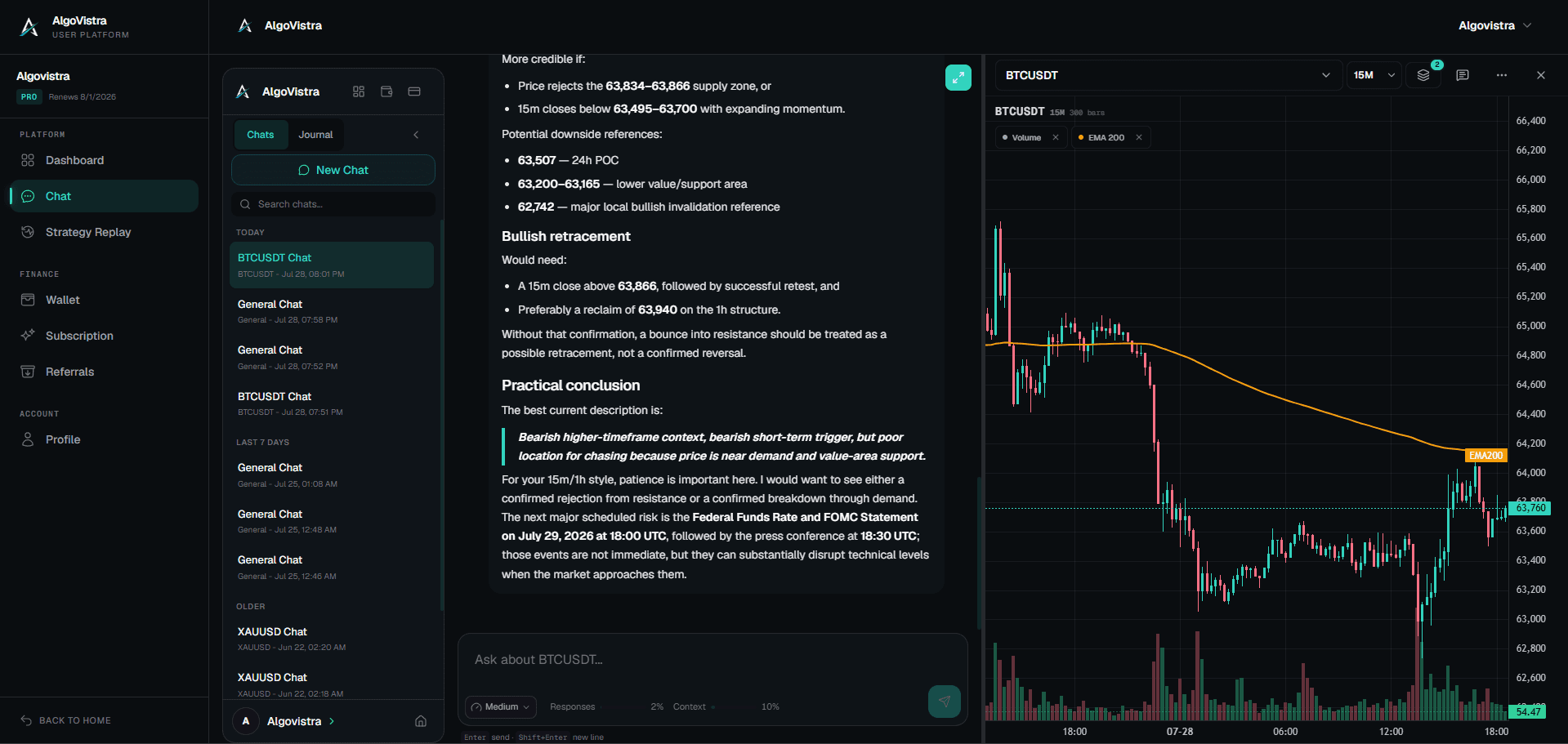
AlgoVistra product screenshot with sample workspace data; it is not verified trading performance.
New traders often confuse AI trading assistants with signal services. Both promise help in the markets, but they work very differently. Understanding the difference protects both your capital and your learning curve.
A signal service tells you what to do. An AI trading assistant helps you understand why you might do it. One hands you a fish; the other teaches you to think about the water.
What a Signal Service Does
Signal services typically send alerts with specific trade instructions:
- Buy EUR/USD at 1.0850
- Stop loss at 1.0820
- Take profit at 1.0900
Some include brief reasoning. Others do not. The user is expected to copy the trade manually or through automation. The service takes responsibility for the call, at least in the user's mind.
Signal services appeal to traders who want results without analysis. The problem is that market conditions change fast. A signal that looked good when it was sent can become dangerous by the time you act. Without understanding the reasoning, you cannot adapt.
What an AI Trading Assistant Does
An AI trading assistant does not send buy-or-sell orders. It analyzes market conditions, explains structure, highlights key levels, and discusses scenarios. It might say something like:
"EUR/USD is testing a prior resistance zone near 1.0850. The 4H structure remains bullish unless price closes below 1.0800. A break above 1.0850 with volume could target 1.0900, while failure here may retest 1.0800."
This is analysis, not a signal. You decide whether to trade, how much to risk, and where to exit.
Key Differences
| Aspect | Signal Service | AI Trading Assistant |
|---|---|---|
| Output | Buy/sell alert | Market analysis and scenarios |
| Reasoning | Often hidden or minimal | Transparent, explorable |
| Learning value | Low | High |
| Adaptation | None in real time | You can ask follow-up questions |
| Risk responsibility | Unclear, often on the user | Clearly on the user |
| Dependency | Creates dependency | Builds independent skill |
Why the Difference Matters
Trading is a skill that requires judgment. Markets are noisy, conditions change, and no strategy wins every time. If you follow signals blindly, you never learn how to handle a trade that moves against you. You also cannot tell whether a losing streak is bad luck or a broken strategy.
An AI trading assistant keeps you in control. It helps you see evidence, test your own ideas, and build a decision process you can review and improve.
When a Signal Service Might Seem Better
Signal services can feel easier in the short term. You do not have to think. But that ease comes with hidden costs:
- You do not know if the signal provider has a real edge.
- You cannot verify whether historical results are real.
- You cannot adapt when market regime changes.
- You are likely to abandon the service after a few losses.
The traders who survive long term usually develop their own process.
How to Use an AI Assistant Like a Pro
Treat the assistant as an on-demand research aid. Use it to:
- Speed up your pre-trade analysis
- Check your own bias before entering
- Learn concepts in live chart context
- Record and review your decisions
- Build a trader profile that improves relevance over time
The assistant answers your questions. You still pull the trigger.
AlgoVistra's Position
AlgoVistra is designed as an AI trading assistant, not a signal service. It provides conditional analysis, key levels, invalidation points, and risk context. It also connects that analysis to a journal and review workflow so you can learn from your actual decisions.
If you are looking for a tool that explains markets instead of shouting orders, an AI trading assistant is the better long-term choice.
Evidence and safety boundary
No assistant should be trusted merely because it sounds confident. The joint SEC, NASAA, and FINRA investor alert on AI investment fraud warns that AI-generated information can be inaccurate, incomplete, misleading, or outdated and should not be the sole basis for an investment decision. The CFTC advisory on AI trading bots similarly warns that AI cannot predict sudden market changes or guarantee returns.
A useful assistant therefore exposes evidence, assumptions, uncertainty, and invalidation. That distinction can be inspected in the sample AlgoVistra screen above: it presents a conditional conclusion, not an instruction to place an order.
Disclaimer: AI trading assistants provide analytical insights for educational and informational purposes. They do not constitute financial advice. Always conduct your own research and use proper risk management.
Ready to Trade Smarter?
Get 10 AI chat messages per day on the free plan. No credit card required.
How to Talk to an AI Trading Assistant: Prompts That Get Better Analysis
Learn how to prompt an AI trading assistant for clearer market analysis, better trade-idea evaluation, and more useful trading education.
May 24, 2026GuideWhat Is an AI Trading Assistant? A Complete Guide for 2026
Learn how AI trading assistants analyze live market data, support trade decisions, and help traders improve through personalized context, journaling, and review.
May 22, 2026GuideCan AI Replace a Trading Mentor? Pros and Limits in 2026
An honest look at where AI trading assistants can substitute for a mentor and where a human mentor is still essential.
June 11, 2026