
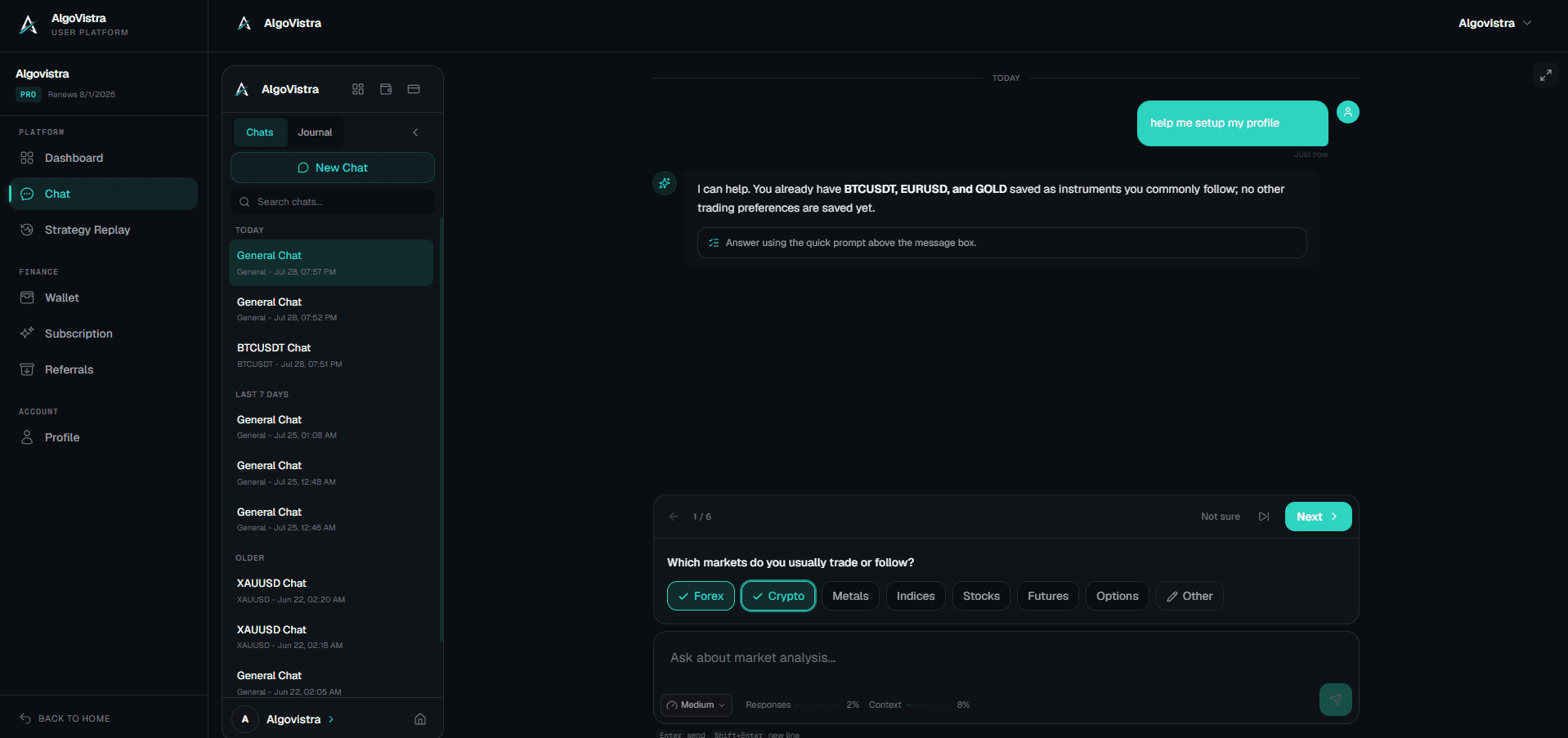
AlgoVistra product screenshot with sample workspace data; it is not verified trading performance.
A good trading mentor can be hard to find and expensive. An AI trading assistant can be available at any time, so it is natural to ask whether it can replace a mentor entirely.
The honest answer is no. AI can support explanation, structured practice, and record review, but that is not the same as observing a trader under pressure, taking professional responsibility, or providing regulated personal advice. Knowing the boundary helps you use both well.
What a Mentor Actually Does
Most traders think a mentor teaches you setups. That is a small part of it. A good mentor usually does several things at once:
- Teaches concepts — explains market structure, risk, and psychology.
- Reviews trades — looks at your actual decisions and points out flaws.
- Provides accountability — checks whether you followed your plan.
- Shares experience — tells you what the market feels like during drawdowns.
- Coaches psychology — helps you manage fear, greed, and boredom.
- Adapts to you — adjusts advice to your personality and constraints.
AI can do some of these very well. Others, it cannot.
Where AI Is a Strong Substitute
Concept Explanations
AI can explain order blocks, liquidity, volume profile, and risk management in seconds. It can also connect those concepts to a live chart in the same conversation.
A mentor might take a 30-minute call to explain fair value gaps. An AI assistant can do it in a few prompts and apply it to the chart you are watching.
Trade Review
This is where AI shines. Feed it your journal and ask:
- "What patterns do you see in my last 30 trades?"
- "Why do my losses cluster on London open?"
- "Where am I breaking my own rules?"
An assistant can process a large structured trade history quickly, subject to context, data-quality, and model limits. Its conclusions should still be checked against the underlying records.
Scenario Discussion
You can run "what if" conversations with the assistant:
- "I am thinking about a long on EUR/USD. What if NFP misses by 0.2%?"
- "What if BTC/USDT sweeps the prior low and reverses?"
These conversations build the kind of situational awareness that takes years to develop on your own.
Always Available
Mentors have schedules. AI does not. You can ask a question at 2am after a surprise move, and the assistant is ready.
Where AI Falls Short
Emotional Coaching
AI can read your journal and notice patterns, but it cannot sit with you during a drawdown. It cannot hear the tension in your voice. It cannot understand that your spouse just lost a job and you cannot afford another loss.
These human moments are where mentorship matters most. A mentor who has been through it can normalize the experience. AI can give you information, but it cannot give you comfort.
Accountability and Pushback
A good mentor will tell you hard truths. "You are overtrading." "You broke your rules." "You are not ready to size up."
AI can flag patterns, but it will not call you on a Friday night and ask why you took that trade. It does not know your life outside the charts. The accountability that comes from another human being is different.
Taste and Judgment
After decades in markets, experienced traders develop "taste" — the ability to sense when a setup is right without being able to fully explain why. This is partly pattern recognition, partly intuition, and partly hard-won experience.
AI can approximate pattern recognition at scale. It cannot replicate intuition built from lived experience. The two are different.
Context Beyond the Chart
A mentor who has lived through 2008, 2020, and multiple crypto cycles can tell you what those periods felt like and how markets behaved. AI can describe them, but it did not live them. There is a difference between knowing that volatility spiked and remembering the feeling of watching your account drop 30% in a week.
The Hybrid Model
A practical option is a hybrid approach.
- Use AI daily — for analysis, journal review, prompt-driven trade evaluation, and concept explanations.
- Use a human mentor occasionally — for emotional coaching, accountability, and big-picture guidance.
- Build a community — for shared experience, support, and learning from others.
This gives you the speed and depth of AI plus the empathy and accountability of a human. It is also usually cheaper than full-time mentoring.
A Practical Hybrid Routine
Daily (AI)
- Pre-session market read
- Trade idea evaluation
- Journal entry and emotional state logging
Weekly (AI)
- Performance review
- Pattern detection across trades
- Plan updates
Monthly (Human or Community)
- Discuss progress with a mentor or trading group
- Review the plan with someone who can challenge it
- Talk about emotional patterns that are hard to see alone
Quarterly (Human or Community)
- Reassess the overall approach
- Decide whether to scale up, change markets, or change style
- Reset risk parameters
The Risk of Over-Reliance
Some traders fall into the trap of treating AI as a parent. They ask the assistant to tell them what to do instead of asking it to help them think. That is a mistake.
A good AI assistant is a thinking partner. A bad one becomes a crutch. The difference is in the questions you ask.
Good questions:
- "What would invalidate my idea?"
- "What patterns do you see in my journal?"
- "What is the risk if I size up here?"
Bad questions:
- "Should I take this trade?"
- "What will EUR/USD do tomorrow?"
- "Can you make me profitable?"
The first set builds your judgment. The second set abandons it.
The Real Answer
AI can assist with some analytical and educational tasks. It cannot reproduce a qualified human's accountability, lived observation, or personal judgment. Use AI within clear limits, seek qualified human help when the stakes require it, and keep developing your own judgment.
Tools can support a process; they cannot supply discipline or accept risk on your behalf.
AlgoVistra is built to be a thinking partner: it explains, organizes, and challenges your reasoning, but it never makes the final decision for you.
What responsible AI support looks like
The NIST AI Risk Management Framework Core calls for documented knowledge limits, defined human oversight, and testing under conditions similar to deployment. The Investor.gov AI alert adds the practical investing rule: independently verify sources and do not rely on AI-generated information alone.
For a trader, that means checking the chart and data timestamp, asking the assistant to state uncertainty, retaining control of risk and execution, and seeking a qualified human when the question involves personal suitability, mental health, or regulated financial advice.
Disclaimer: AI trading assistants provide analytical insights for educational and informational purposes. They do not constitute financial advice. Always conduct your own research and use proper risk management.
Ready to Trade Smarter?
Get 10 AI chat messages per day on the free plan. No credit card required.
AI Trading Assistant vs Signal Service: What Is the Difference?
Understand the real difference between an AI trading assistant and a signal service, and why one supports your decisions while the other tries to replace them.
May 25, 2026GuideHow to Talk to an AI Trading Assistant: Prompts That Get Better Analysis
Learn how to prompt an AI trading assistant for clearer market analysis, better trade-idea evaluation, and more useful trading education.
May 24, 2026GuideWhat Is an AI Trading Assistant? A Complete Guide for 2026
Learn how AI trading assistants analyze live market data, support trade decisions, and help traders improve through personalized context, journaling, and review.
May 22, 2026