
From Demo to Live: Using AI Analysis to Practice Without Risking Capital
A practical workflow for using an AI trading assistant to practice analysis, build a process, and transition from demo to live trading.
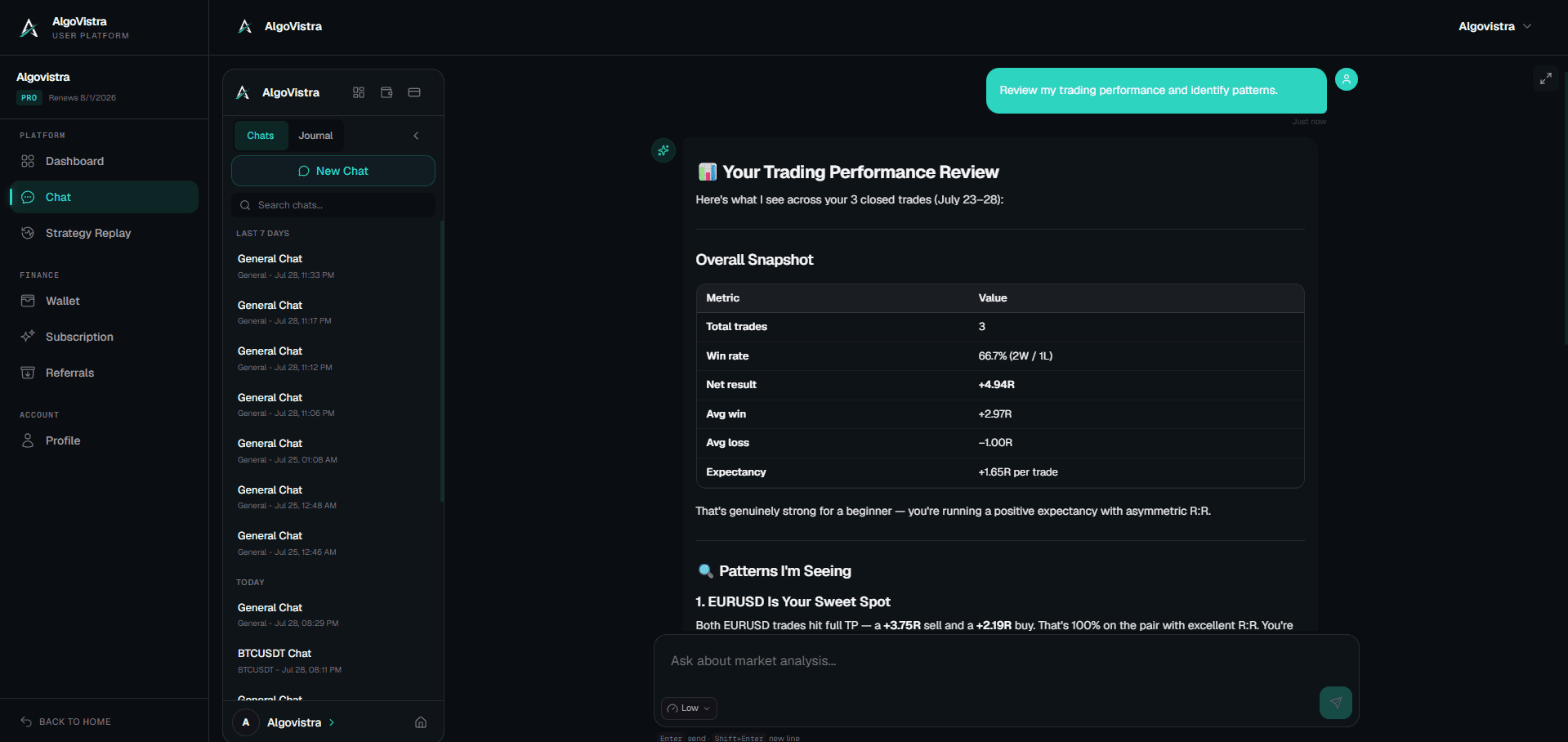
AlgoVistra product screenshot with sample workspace data; it is not verified trading performance.
Most new traders go to live markets too early. They lose money, lose confidence, and quit. The ones who succeed usually spent serious time on a demo account first, not clicking randomly, but practicing a real process.
An AI trading assistant makes practice more useful because it gives you structured feedback on every decision. This guide shows how to use that to build a real process before risking capital.
Why Demo Trading Often Fails
Demo trading is supposed to be a safe training ground. In practice, it teaches bad habits:
- No emotional weight — clicking buy on fake money is not the same as clicking buy on real money.
- No risk of ruin — oversizing, revenge, and chaos have no consequences.
- Random process — without a plan, demo trades are just guesses.
- No feedback loop — wins and losses are not connected to reasoning.
To make demo trading useful, you need to treat it like a job: a plan, a routine, a review, and real journaling.
The 30-Day Practice Plan
A focused 30-day practice plan is a useful starting point. It will either build a clearer picture of your process or expose that it is not ready yet. Treat 30 days as a minimum review milestone, not a guarantee of readiness: sample size and consistency matter more than the calendar.
Week 1: Set Up the Foundation
- Define one to three setups you want to practice.
- Write a short trading plan with risk rules and session focus.
- Configure your trader profile with your style, risk limits, and rules.
- Identify the pairs and timeframes you will focus on.
Week 2: Practice Analysis Without Trading
For five days, do not place any trades. Instead, every session:
- Identify one potential setup.
- Write the entry, stop, and target.
- Record the setup in your journal without taking it.
- At the end of the day, mark whether the trade would have worked.
This builds analysis discipline without emotional pressure.
Week 3: Take Demo Trades With Full Process
Now take trades, but only when they match your plan. For each trade:
- Use a pre-trade checklist.
- Place the trade on the demo account.
- Log it in your journal with full fields.
- Take a screenshot of the chart at entry.
Week 4: Review and Decide
At the end of week 4, review your journal:
- Did you follow your plan?
- What was your win rate and average R:R?
- Did you break any rules?
- How did you feel during the trades?
Positive answers may justify continuing the evaluation or beginning a very small live-observation phase. They do not establish profitability or readiness to increase risk. If not, repeat week 3.
How AI Helps During Practice
An AI trading assistant is useful in every phase of practice.
Setup Validation
Before the trade, ask:
- "Is the current structure on EUR/USD 4H supportive of a long?"
- "What is the nearest high-volume node above 1.0850?"
The assistant can provide an additional structured interpretation that you can compare with the chart and source data before you commit.
Trade Idea Evaluation
Share your plan and ask:
- "I am considering a long at 1.0850, stop 1.0820, target 1.0900. What would invalidate this idea?"
This makes you articulate your reasoning, which is the most important habit to build.
Post-Trade Discussion
After a demo trade:
- "I exited my EUR/USD long at breakeven. Was that the right call given the 4H structure?"
The assistant cannot know the future, but it can help you evaluate decisions against the chart context.
Process Reviews
At the end of each week, ask:
- "Based on my journal entries, what patterns do you see in my demo trades?"
The assistant can surface patterns and issues to check, but you should verify them against the chart and your own records.
Product example: This sample review deliberately calls out its three-trade dataset as too small for a strong conclusion. That is the correct behavior: a review should expose sample size and process notes instead of turning a short winning run into a claim of readiness.
The Transition to Live
When you are ready to trade real money, do it gradually.
Step 1: Reduce Size
If you choose to move beyond demo, begin with an amount whose complete loss would not affect essential expenses and define the review sample in advance. The point is not short-term profit; it is to observe execution and decision-making under real conditions without creating financial pressure.
Step 2: Keep the Same Process
Do not change your plan because money is on the line. If your demo process was consistent, the same process is a reasonable starting point live, scaled to your size. Demo results never guarantee live results: execution, trading costs, and emotional pressure all differ in real markets.
Step 3: Journal Everything
Live trades should be journaled with even more detail than demo trades. Emotional state matters more when real money is involved.
Step 4: Review After 20 Trades
After 20 live trades, compare your live results with your demo results. Twenty trades is a small sample, so treat the comparison as early evidence rather than proof.
- If your live results are similar, your process is holding up so far.
- If your live results are much worse, the emotional load may be affecting execution. Reduce size further or pause rather than pushing through.
Step 5: Scale Slowly
Only increase size after another 20 to 30 trades of consistency, and increase by no more than 25% at a time as an illustrative starting rule. Adjust the thresholds to your own sample size, variance, and loss tolerance.
Common Practice Mistakes
- Skipping the plan — without a plan, practice is just clicking.
- Overtrading to "get experience" — quality matters more than quantity.
- Ignoring emotional state — record how you feel during each trade.
- Switching pairs constantly — focus on two or three to learn them well.
- Not journaling — undocumented trades are wasted trades.
The Real Value of AI-Assisted Practice
The benefit of using an AI assistant during practice is not that it gives you magic insights. The benefit is that it forces you to articulate your reasoning. Every prompt you write is a question about your own thinking. Over time, this builds the habit of thinking clearly before acting.
That habit is what carries you through real markets.
AlgoVistra is built to support this kind of practice: structured prompts, persistent trader profile, journaling, visual review, and AI feedback in one workspace.
A readiness test that does not use profit alone
Demo profit is hypothetical and can hide costs, execution pressure, and missed trades. Before moving to live trading, freeze the rules for a defined sample, log every valid setup, include spread and commission assumptions, and review rule adherence separately from P&L. Then begin with an amount whose loss would not affect essential expenses.
The FINRA day-trading risk disclosure stresses experience, trading costs, execution risk, and the possibility of losing all funds used for day trading. The SEC's explanation of hypothetical performance explains why assumptions, risks, and limitations must accompany simulated results. A demo phase is evidence of process practice, not proof of future profitability.
Disclaimer: AI trading assistants provide analytical insights for educational and informational purposes. They do not constitute financial advice. Always conduct your own research and use proper risk management.
Ready to Trade Smarter?
Get 10 AI chat messages per day on the free plan. No credit card required.
Risk Management for AI-Assisted Traders
Risk management principles for traders who use AI assistants: position sizing, stop placement, and how to keep human judgment in the loop.
June 7, 2026GuideHow to Evaluate a Trade Idea Before You Enter
A practical checklist for evaluating trade ideas before placing an order, so you trade with reasoning instead of hope.
June 6, 2026GuideTrading Performance Review: A Weekly Routine Using AI
A repeatable weekly review routine that uses your trading journal, statistics, and an AI assistant to improve your process.
June 3, 2026