
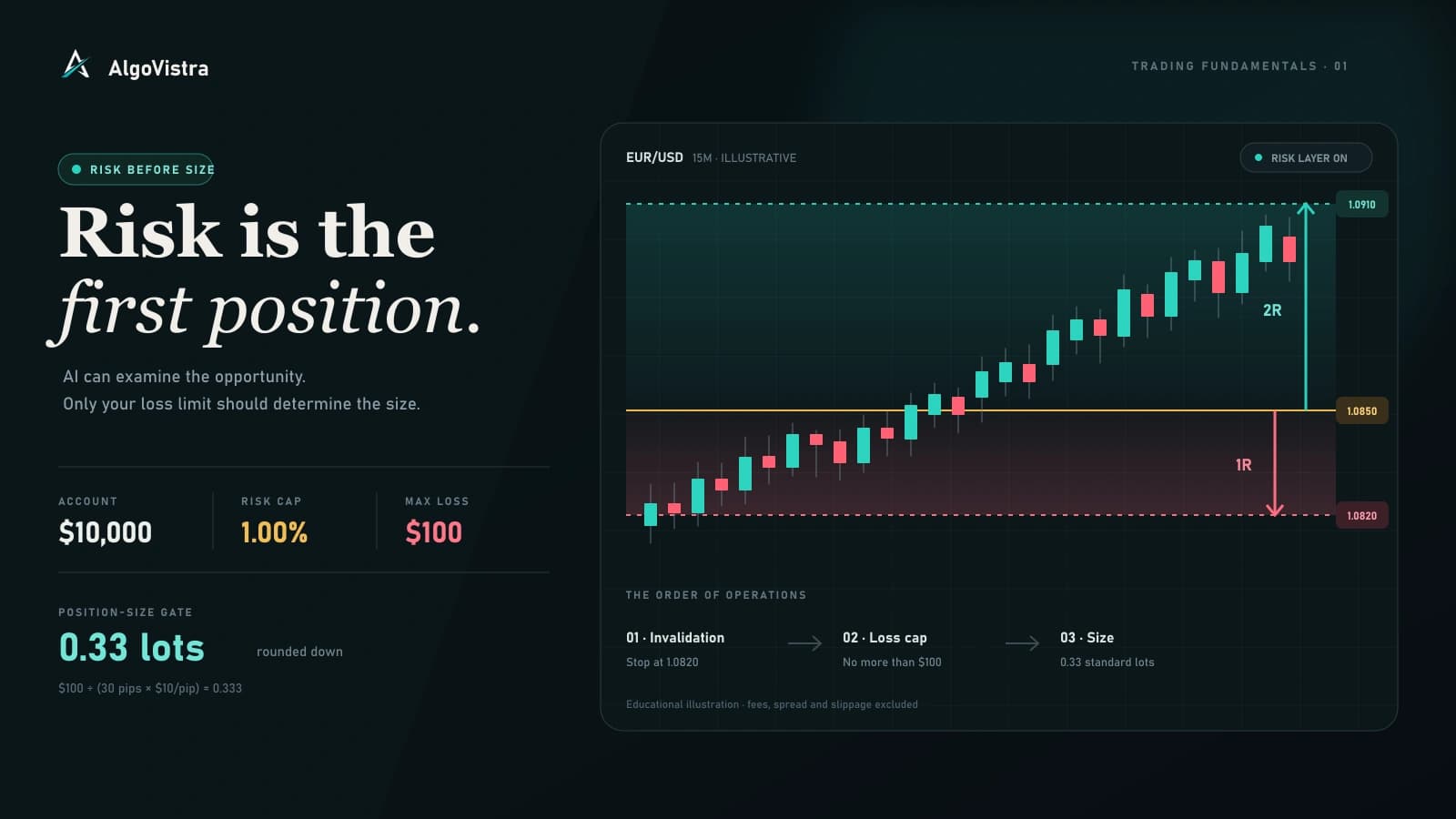
Original AlgoVistra educational diagram; illustrative only, not live market data.
AI assistants can speed up your analysis, but they cannot protect your account. That is still your job. Risk management is what separates traders who survive long enough to improve from those who blow up before they learn anything.
This guide covers the risk management principles that matter most when you trade with AI analysis.
The One Rule Above All
Set a maximum cash loss before calculating position size. If a routine losing streak would damage your finances or essential expenses, the amount at risk is too high. There is no universal “professional” percentage: the appropriate limit depends on the product, leverage, liquidity, account terms, financial situation, and ability to tolerate loss.
Position Sizing Is Not Optional
Most new traders size positions by gut feel. They place "a small position" or "a normal position." That is not sizing. Sizing is a calculation.
The basic formula:
Position size = account risk amount / distance between entry and stop
Example:
- Account: $10,000
- Risk per trade: 1% = $100
- Entry: 1.0850
- Stop: 1.0820
- Risk distance: 30 pips
- For a forex pair, 1 standard lot = $10 per pip
- Position size = $100 / (30 × $10) = 0.33 lots
If the calculated size feels too small, do not increase it merely to make the potential profit feel worthwhile. Recheck the inputs or skip the idea.
Where to Place the Stop
A stop is not an arbitrary number. It is a level where your idea is proven wrong. The most common valid stop placements:
- Below structure — under a swing low, demand zone, or order block
- Above structure — above a swing high, supply zone, or order block
- Beyond a key level — past the point of control or a major volume node
- ATR-based — 1 to 1.5 times the Average True Range of the timeframe
A stop placed because "30 pips feels right" is not a stop. It is a guess.
The Dangers of Using AI Without Discipline
AI assistants make it easy to act fast. They can give you a structured read in seconds. That is great for analysis and dangerous for execution.
Common traps:
- Overtrading — fast answers encourage more trades, not better trades.
- Trusting the AI on every pair — the assistant explains; you decide.
- Skipping the stop because "AI confirmed" — confirmation is not protection.
- Larger size because the setup looks clean — clean setups can still fail.
The assistant is a tool, not a shield. Risk management is the shield.
Use AI to Plan, Not to React
A good workflow uses the AI to plan trades in advance, not to chase the market in the moment.
Pre-Session Planning (5–15 minutes)
- Ask for the daily and 4H structure of the pairs you trade.
- Identify key levels and zones.
- Mark potential setups in your plan.
- Decide what news or events to avoid.
Trade-Time Decisions (per trade)
- Confirm the setup is still valid.
- Ask for invalidation levels.
- Place entry, stop, and target based on structure, not gut feel.
Post-Trade Logging
- Record the trade in your journal.
- Add emotional state and any rule you broke.
This rhythm keeps you ahead of the market instead of reacting to it.
Risk Rules Worth Storing in Your Trader Profile
A persistent trader profile in AlgoVistra can store rules like:
- Maximum risk per trade: 1%
- Daily loss limit: 2%
- Maximum open positions: 3
- No new trades 30 minutes after a loss
- Stop must be below structure, not on a round number
- No moving stops against the original level
These are examples of the shape such rules take, not universal recommendations. Choose thresholds that fit your own financial situation, product leverage, and ability to tolerate loss.
The assistant can reference these rules in future conversations, which helps you follow them even when you do not feel like it.
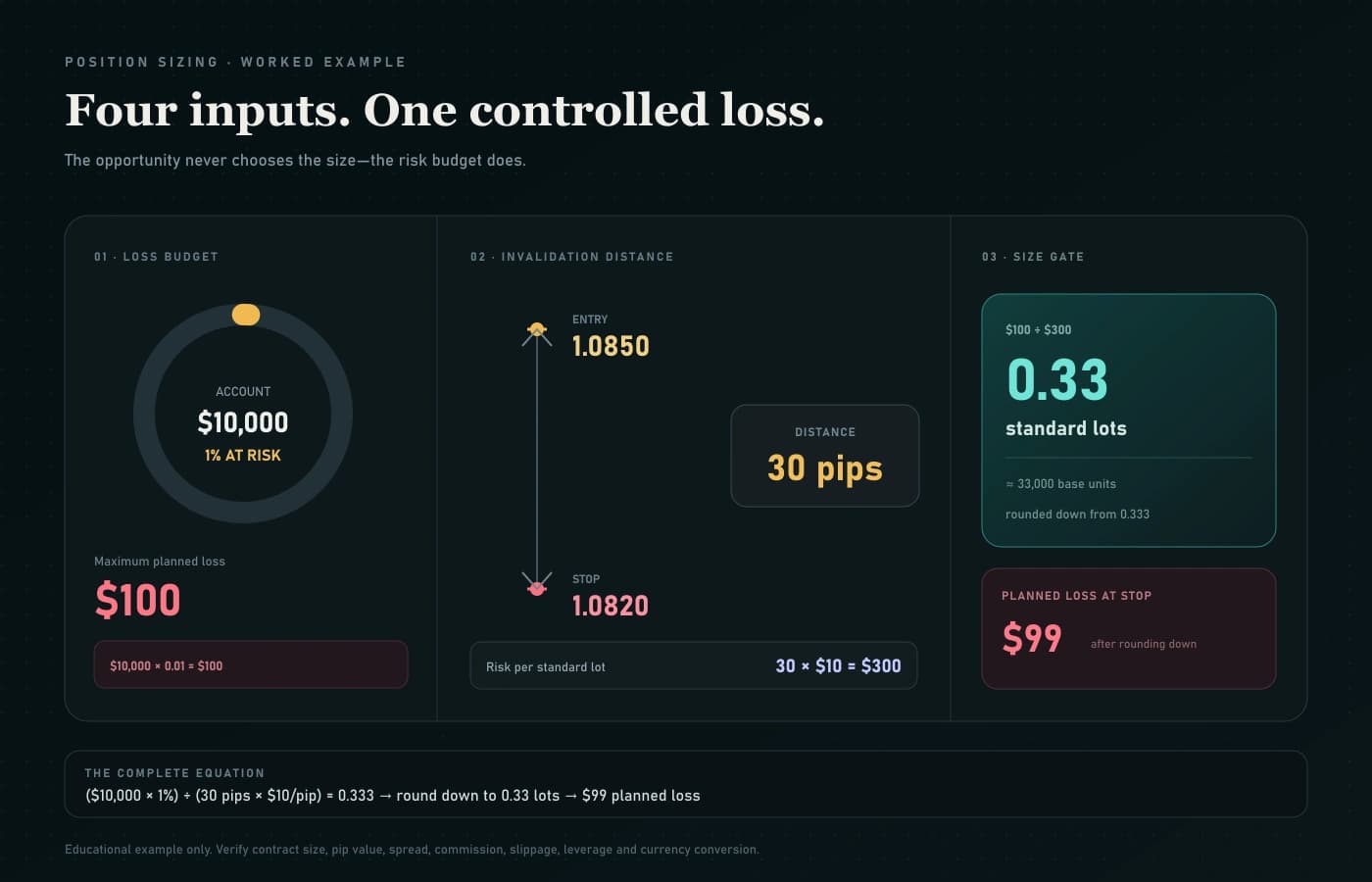
Worked example: A $10,000 account risking 1% has a $100 maximum planned loss. With a 30-pip stop and an illustrative pip value of $10 per standard lot, the unrounded size is 0.333 lots. Rounding down to 0.33 lots produces a $99 planned loss before spread, commission, slippage, and currency conversion.
Scaling Up Safely
Once you have a track record, it is tempting to increase size. Do it slowly. The numbers below are illustrative thresholds to adapt to your own sample and risk tolerance, not fixed rules:
- A common starting convention is to scale up only after at least 50 trades following your current rules.
- Increase risk per trade by no more than 0.25% at a time.
- Re-evaluate after another 50 trades.
- If a higher size produces worse results, return to the previous size.
Bigger size exposes weaknesses that smaller size hides. Build the process first, then grow the size.
Drawdown Rules
A drawdown is a period of losses. Every trader has them. The danger is not the drawdown itself but the emotional decisions it triggers.
Pre-commit to rules. The following are illustrative examples of the shape such rules take — pick thresholds that match your own account and risk tolerance:
- After 3% account drawdown, reduce size by 50% for the next 10 trades.
- After 5% account drawdown, pause for one full session.
- After 10% account drawdown, stop and review the entire process.
Write these rules before you need them. You will not think clearly during a drawdown.
The Limits of AI Risk Tools
AI assistants do not have your money. They do not feel the pain of a loss. They cannot force you to follow your rules. They can:
- Help you compute position size
- Remind you of your stored rules
- Explain invalidation in context
- Help you review results over time
Use them for these. Do not use them as a replacement for discipline.
Why Survival Matters
The traders who survive long enough to win are not the ones with the best indicators or the most signals. They are the ones who manage risk so well that they get to play another day. AI analysis makes the inputs better. Risk management makes the outcomes survivable.
AlgoVistra combines AI analysis, a persistent trader profile with risk rules, a journal for tracking results, and visual review — all in one workspace.
Risk sources and calculator checks
The FINRA day-trading risk disclosure warns about large and immediate losses, execution problems, accumulated trading costs, and losses beyond the initial investment when borrowing or shorting. The CFTC forex advisory explains how leverage amplifies both gains and losses in OTC forex.
Before relying on a position-size output, unit-test it against hand calculations for long and short trades, zero-decimal and non-USD quote currencies, contract multipliers, tick values, fees, spread, and gap-through-stop scenarios. The simplified diagram above is educational; it is not a universal calculator for every instrument.
Disclaimer: AI trading assistants provide analytical insights for educational and informational purposes. They do not constitute financial advice. Always conduct your own research and use proper risk management.
Ready to Trade Smarter?
Get 10 AI chat messages per day on the free plan. No credit card required.
How to Evaluate a Trade Idea Before You Enter
A practical checklist for evaluating trade ideas before placing an order, so you trade with reasoning instead of hope.
June 6, 2026GuideFrom Demo to Live: Using AI Analysis to Practice Without Risking Capital
A practical workflow for using an AI trading assistant to practice analysis, build a process, and transition from demo to live trading.
June 10, 2026GuideHow to Backtest a Discretionary Trading Strategy with AI
See how the coming-soon AI Strategy Replay workflow will turn a plain-language strategy into a structured historical review.
July 19, 2026