
What Is AI Strategy Replay? Backtesting for Discretionary Traders
See how the coming-soon AI Strategy Replay feature will test plain-language discretionary strategies across historical candles without forcing every decision into rigid code.
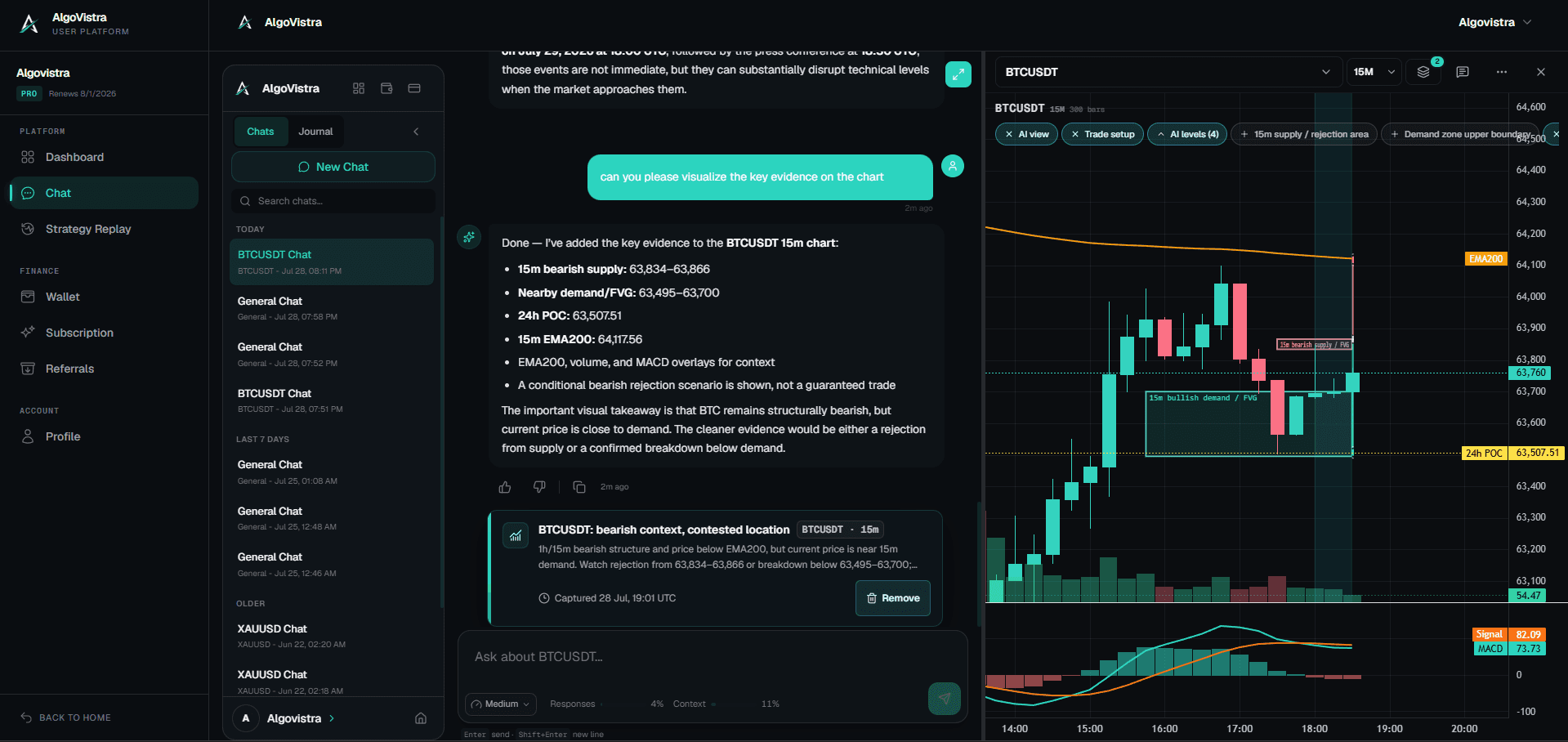
AlgoVistra product screenshot with sample workspace data; it is not verified trading performance.
Traditional backtests are excellent when every rule can be expressed as exact mathematics. If the fast EMA crosses the slow EMA and volume is above a fixed threshold, code can test that condition quickly and consistently.
But many traders do not trade that way. Their strategy may depend on whether a liquidity sweep looks meaningful, whether a zone is still valid, whether structure supports the direction, or whether several imperfect clues tell the same story. Turning that judgment into hundreds of rigid conditions can distort the original idea.
Coming soon: AI Strategy Replay will let a trader describe a strategy in plain language, move through past candles in order, and review which historical setups the AI would have accepted or skipped. This article explains the intended workflow; the feature is not available yet.
AI Strategy Replay is designed for that gap. It tests a plain-language discretionary strategy over historical candles using transparent filters and context-aware AI decisions. It is not a replacement for deterministic backtesting. It is a different research tool for a different kind of strategy.
The Core Idea
A replay moves through historical candles in chronological order. Before AI is involved, inexpensive filters decide whether the current candle deserves deeper review.
The workflow has four stages:
- Describe the strategy and choose the historical scope.
- Filter candles using required conditions and a confluence score.
- Verify the path to estimate how many candles will reach AI.
- Run the qualified moments through a consistent AI decision process.
This separation matters. A five-minute chart can contain thousands of candles in a month. Calling AI on every candle would be slow, expensive, and analytically noisy. The filters make AI the final judge, not the first line of computation.
Required Filters and Score Filters
Not every condition plays the same role in a discretionary setup.
A required filter is absolute. If it fails, the candle is skipped. You might require the direction to be long only, demand a safe news state when news data exists, or insist that price is near a selected zone.
A score filter represents supporting confluence. Trend bias, EMA alignment, session context, and momentum may each add one point. The candle continues only when the score reaches the threshold you selected—for example, three of four conditions.
This mirrors real decision-making better than pretending every piece of evidence is equally mandatory.
Verify Path Before Spending AI Capacity
The preflight step is one of the most important parts of AI Strategy Replay. Verify Path scans the selected candle range using filters only. It can show:
- Total candles in the requested period
- Candles skipped by required conditions
- Candidate candles that would reach AI
- Filters that failed or matched most often
- The distribution of confluence scores
- Estimated AI calls, usage, and runtime
You can then tighten an overly broad strategy, loosen a path that produces almost no candidates, or approve the replay with a clear idea of its workload.
What the AI Sees
The AI should see only information that would have been available at the decision candle. The market overview and execution-timeframe detail form the base context. The trader can also include detailed snapshots and evidence from selected additional timeframes.
That distinction is important. A higher timeframe used by a filter is a condition setting. The timeframes included in the AI snapshot control the evidence available to the decision. They solve different problems.
For a qualified moment, the AI can return a simple decision: enter or skip, direction, mandatory stop loss, and a take-profit price or reward-to-risk target. A replay can keep one simulated trade open at a time so the result remains understandable.
What Results Mean—and What They Do Not
AI replay is not deterministic in the same way as a short mathematical script. Model behavior, prompt versions, and context design matter. Each run should therefore record the model tier and system-prompt version used.
Initial results can report gross pips or points and gross price return. They do not include spread, slippage, commission, platform fees, or overnight swap. That makes them useful for early research, but insufficient as a prediction of live performance.
The replay also does not execute trades, connect to a broker, or guarantee that a strategy has an edge. It helps a trader examine how a clearly stated discretionary process behaves across historical conditions.
When to Use PineScript Instead
Use a deterministic backtester when your strategy is fully mechanical. Exact indicator rules, fixed session windows, mathematical position sizing, and unambiguous exits belong in code. It will be faster and cheaper, and repeatable under fixed code, data, configuration, and execution assumptions.
Use AI Strategy Replay when the strategy includes language such as:
- “A clean rejection from demand”
- “Structure still supports the move”
- “The sweep is meaningful, not random noise”
- “Enough confluence exists to justify the risk”
The best research process may use both: code for what is exact, AI for what requires contextual judgment.
A Better Question Than “Did It Win?”
The first purpose of a replay is not to produce an impressive win rate. It is to expose the strategy.
Does the description lead to consistent decisions? Do the filters remove the right parts of the market? Are candidates concentrated in one regime? Does the AI skip unclear setups? Do losses reveal a missing invalidation rule?
Those questions turn historical testing into process improvement. That is the real promise of AI Strategy Replay: not certainty, but a more practical way to examine strategies that live between code and human judgment.
See the AI Strategy Replay feature preview or compare AlgoVistra plans.
Research standard used for this guide
This article describes a research workflow, not a completed performance study. A defensible replay should preserve the information available at each historical decision point, record ambiguous cases, include realistic costs, and keep an untouched out-of-sample period. Report the exact market, timeframe, date range, sample count, rule version, cost assumptions, and rejected cases alongside any result.
The CFA Institute overview of backtesting and simulation highlights look-ahead bias, survivorship bias, structural breaks, and the role of rolling or walk-forward tests. The SEC's discussion of hypothetical performance explains why users need the criteria, assumptions, risks, and limitations required to understand a backtest. The NFA's interpretive notice on hypothetical performance adds that such results are generally designed with the benefit of hindsight and may under- or over-compensate for factors such as lack of liquidity and price slippage. These are the standards a future AlgoVistra replay report should make visible.
Disclaimer: AI Strategy Replay provides historical research and educational decision support. It does not provide financial advice, execute trades, or guarantee future results. Gross replay results may omit material trading costs.
AI Strategy Replay
Coming soonAI Strategy Replay is coming soon. It will let you describe a discretionary strategy in plain language, filter historical candles by your rules, and use AI to simulate decisions on the setups that qualify. Plus will include Low, Medium, High; Pro will also include Max.
How to Backtest a Discretionary Trading Strategy with AI
See how the coming-soon AI Strategy Replay workflow will turn a plain-language strategy into a structured historical review.
July 19, 2026GuideMulti-Timeframe Analysis: How to Align Daily, 4H, and 1H Charts
Learn how to use multi-timeframe analysis to identify trend direction, key levels, and better entry timing in forex, crypto, and gold markets.
May 28, 2026GuideCrypto vs Forex: Which Market Suits AI Analysis Better?
A balanced comparison of crypto and forex for AI-assisted analysis, covering liquidity, volatility, news sensitivity, and workflow.
June 9, 2026